I am shipping orders on Thursday this week. News and More Info
Not what you want?
Try other similar-meaning words, fewer words, or just one word.
Feel free to email me with your request. If it's easy, I'll translate it for free and add it to this database of calligraphy for you.
Buy a Take Up a Challenge calligraphy wall scroll here!
Personalize your custom “Take Up a Challenge” project by clicking the button next to your favorite “Take Up a Challenge” title below...
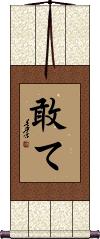
敢て is a Japanese word that can mean a few things related to the idea of taking up a challenge.
It can be defined as daring (to do something), venturing (often overcoming reluctance), or taking action (even in the face of probable failure). It can also be to take upon oneself or take up a challenge.
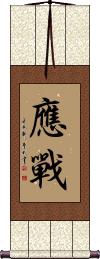
應戰 is a Chinese word that means “to take up a challenge” or “to face an attack and meet it.”
Below are some entries from our dictionary that may match your Take Up a Challenge search...
| Characters If shown, 2nd row is Simp. Chinese |
Pronunciation Romanization |
Simple Dictionary Definition |
將軍 将军 see styles |
jiāng jun jiang1 jun1 chiang chün |
More info & calligraphy: Chinese or Korean Army General |
應戰 应战 see styles |
yìng zhàn ying4 zhan4 ying chan |
More info & calligraphy: Take Up a Challenge |
搦 see styles |
nuò nuo4 no karami からみ |
(literary) to hold (in the hand); to challenge; to provoke (place-name) Karami |
PK see styles |
p k p k p k pii kee; piikee(sk); piikei(sk) / pi kee; pikee(sk); pike(sk) ピー・ケー; ピーケー(sk); ピーケイ(sk) |
(slang) to take on; to challenge; to go head to head; showdown; comparison (1) (abbreviation) {sports} (See ペナルティーキック) penalty kick; (2) (abbreviation) (See サイコキネシス) psychokinesis; (3) (abbreviation) (See パルクール) parkour |
仕掛 see styles |
shikake しかけ |
(1) device; contrivance; mechanism; gadget; (2) trick; trap; calculated manipulation; gambit; (3) (small) scale; half finished; (4) commencement; initiation; (5) set up; laying out; preparation; (6) challenge; attack |
動搖 动摇 see styles |
dòng yáo dong4 yao2 tung yao dōyō |
to sway; to waver; to rock; to rattle; to destabilize; to pose a challenge to tremble |
叫板 see styles |
jiào bǎn jiao4 ban3 chiao pan |
to signal the musicians (in Chinese opera, by prolonging a spoken word before attacking a song); (coll.) to challenge |
叫陣 叫阵 see styles |
jiào zhèn jiao4 zhen4 chiao chen |
to challenge an opponent to a fight |
命題 命题 see styles |
mìng tí ming4 ti2 ming t`i ming ti meidai / medai めいだい |
proposition (logic, math.); to assign an essay topic (noun - becomes adjective with の) (1) proposition; thesis; notion; theory; (noun - becomes adjective with の) (2) problem; issue; challenge thesis |
忌避 see styles |
jì bì ji4 bi4 chi pi kihi きひ |
(n,vs,vt,vi) (1) evasion; avoidance; shirking; (n,vs,vt,vi) (2) {law} recusation (of a judge); taking exception (to a judge); challenge to avoid |
応戦 see styles |
ousen / osen おうせん |
(n,vs,vi) fighting back; returning fire; counter-attack; responding to an attack; accepting a challenge |
戰書 战书 see styles |
zhàn shū zhan4 shu1 chan shu |
written war challenge |
挑む see styles |
idomu いどむ |
(transitive verb) (1) to challenge to (a fight, game, etc.); to throw down the gauntlet; to contend for; (v5m,vi) (2) to tackle (e.g. a problem); to attempt; to go after (a prize, record, etc.); (v5m,vi) (3) to pressure (someone) for sex; to make advances to |
挑戦 see styles |
chousen / chosen ちょうせん |
(n,vs,vi) challenge; defiance; dare; attempt; try |
挑戰 挑战 see styles |
tiǎo zhàn tiao3 zhan4 t`iao chan tiao chan |
to challenge; challenge |
搦戰 搦战 see styles |
nuò zhàn nuo4 zhan4 no chan |
to challenge to battle |
申込 see styles |
moushikomi / moshikomi もうしこみ |
application; entry; request; subscription; offer; proposal; overture; challenge |
硬仗 see styles |
yìng zhàng ying4 zhang4 ying chang |
tough battle; difficult task; big challenge |
童趣 see styles |
tóng qù tong2 qu4 t`ung ch`ü tung chü |
qualities that delight children (e.g. bold colors in a picture, anthropomorphized characters in a TV show, the physical challenge of playground equipment) |
肉迫 see styles |
nikuhaku にくはく |
(noun/participle) come close to; closing in upon; pressing hard (on the enemy); challenge |
臨み see styles |
nozomi のぞみ |
challenge; confrontation |
課題 课题 see styles |
kè tí ke4 ti2 k`o t`i ko ti kadai かだい |
task; problem; issue (1) subject; theme; issue; matter; (2) homework; assignment; (3) problem (that needs solving); task; challenge; question |
踢館 踢馆 see styles |
tī guǎn ti1 guan3 t`i kuan ti kuan |
to challenge an established martial arts school to a fight (to prove one's skills or gain reputation); (fig.) to prove oneself by competing against those already established in a particular field |
難題 难题 see styles |
nán tí nan2 ti2 nan t`i nan ti nandai なんだい |
difficult problem difficult problem; challenge |
ウケる see styles |
ukeru ウケる |
(transitive verb) (1) to receive; to get; (2) to catch (e.g. a ball); (3) to be struck by (wind, waves, sunlight, etc.); (4) to sustain (damage); to incur (a loss); to suffer (an injury); to feel (influence); (5) to undergo (e.g. surgery); to take (a test); to accept (a challenge); (6) to be given (e.g. life, talent); (7) to follow; to succeed; to be descended from; (8) to face (south, etc.); (9) (linguistics terminology) to be modified by; (10) to obtain (a pawned item, etc.) by paying a fee; (v1,vi) (11) (kana only) to be well-received; to become popular; to go down well; (12) (colloquialism) (kana only) to be funny; to be humorous |
享ける see styles |
ukeru うける |
(transitive verb) (1) to receive; to get; (2) to catch (e.g. a ball); (3) to be struck by (wind, waves, sunlight, etc.); (4) to sustain (damage); to incur (a loss); to suffer (an injury); to feel (influence); (5) to undergo (e.g. surgery); to take (a test); to accept (a challenge); (6) to be given (e.g. life, talent); (7) to follow; to succeed; to be descended from; (8) to face (south, etc.); (9) (linguistics terminology) to be modified by; (10) to obtain (a pawned item, etc.) by paying a fee; (v1,vi) (11) (kana only) to be well-received; to become popular; to go down well; (12) (colloquialism) (kana only) to be funny; to be humorous |
仕掛け see styles |
shikake しかけ |
(1) device; contrivance; mechanism; gadget; (2) trick; trap; calculated manipulation; gambit; (3) (small) scale; half finished; (4) commencement; initiation; (5) set up; laying out; preparation; (6) challenge; attack |
初挑戦 see styles |
hatsuchousen / hatsuchosen はつちょうせん |
first challenge; first try |
受ける see styles |
ukeru うける |
(transitive verb) (1) to receive; to get; (2) to catch (e.g. a ball); (3) to be struck by (wind, waves, sunlight, etc.); (4) to sustain (damage); to incur (a loss); to suffer (an injury); to feel (influence); (5) to undergo (e.g. surgery); to take (a test); to accept (a challenge); (6) to be given (e.g. life, talent); (7) to follow; to succeed; to be descended from; (8) to face (south, etc.); (9) (linguistics terminology) to be modified by; (10) to obtain (a pawned item, etc.) by paying a fee; (v1,vi) (11) (kana only) to be well-received; to become popular; to go down well; (12) (colloquialism) (kana only) to be funny; to be humorous |
咎める see styles |
togameru とがめる |
(transitive verb) (1) to blame; to reproach; to censure; to rebuke; to reprove; to find fault; to take to task; to criticize; to criticise; (transitive verb) (2) to question (a suspect); to challenge; (Ichidan verb) (3) to aggravate (an injury); to be aggravated; to get inflamed; (v1,vi) (4) (See 気が咎める) to prick (one's conscience) |
The following table may be helpful for those studying Chinese or Japanese...
| Title | Characters | Romaji (Romanized Japanese) | Various forms of Romanized Chinese | |
| Take Up a Challenge | 敢て | aete | ||
| Take Up a Challenge | 應戰 应战 | yìng zhàn ying4 zhan4 ying zhan yingzhan | ying chan yingchan |
|
| In some entries above you will see that characters have different versions above and below a line. In these cases, the characters above the line are Traditional Chinese, while the ones below are Simplified Chinese. | ||||
Successful Chinese Character and Japanese Kanji calligraphy searches within the last few hours...

All of our calligraphy wall scrolls are handmade.
When the calligrapher finishes creating your artwork, it is taken to my art mounting workshop in Beijing where a wall scroll is made by hand from a combination of silk, rice paper, and wood.
After we create your wall scroll, it takes at least two weeks for air mail delivery from Beijing to you.
Allow a few weeks for delivery. Rush service speeds it up by a week or two for $10!
When you select your calligraphy, you'll be taken to another page where you can choose various custom options.
The wall scroll that Sandy is holding in this picture is a "large size"
single-character wall scroll.
We also offer custom wall scrolls in small, medium, and an even-larger jumbo size.
Professional calligraphers are getting to be hard to find these days.
Instead of drawing characters by hand, the new generation in China merely type roman letters into their computer keyboards and pick the character that they want from a list that pops up.
There is some fear that true Chinese calligraphy may become a lost art in the coming years. Many art institutes in China are now promoting calligraphy programs in hopes of keeping this unique form
of art alive.
Even with the teachings of a top-ranked calligrapher in China, my calligraphy will never be good enough to sell. I will leave that to the experts.
The same calligrapher who gave me those lessons also attracted a crowd of thousands and a TV crew as he created characters over 6-feet high. He happens to be ranked as one of the top 100 calligraphers in all of China. He is also one of very few that would actually attempt such a feat.
Check out my lists of Japanese Kanji Calligraphy Wall Scrolls and Old Korean Hanja Calligraphy Wall Scrolls.
Some people may refer to this entry as Take Up a Challenge Kanji, Take Up a Challenge Characters, Take Up a Challenge in Mandarin Chinese, Take Up a Challenge Characters, Take Up a Challenge in Chinese Writing, Take Up a Challenge in Japanese Writing, Take Up a Challenge in Asian Writing, Take Up a Challenge Ideograms, Chinese Take Up a Challenge symbols, Take Up a Challenge Hieroglyphics, Take Up a Challenge Glyphs, Take Up a Challenge in Chinese Letters, Take Up a Challenge Hanzi, Take Up a Challenge in Japanese Kanji, Take Up a Challenge Pictograms, Take Up a Challenge in the Chinese Written-Language, or Take Up a Challenge in the Japanese Written-Language.