Many custom options...


And formats...



Spell in Chinese / Japanese...
Buy a Spell calligraphy wall scroll here!
Personalize your custom “Spell” project by clicking the button next to your favorite “Spell” title below...
Spell

斯佩爾 is the name Spell in Chinese (Mandarin).
Spell

スペル is the name Spell in Japanese Katakana.
Note: Because this title is entirely Japanese Katakana, it should be written by a Japanese calligrapher.
Nevaeh
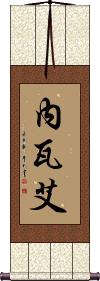
This is a common transliteration to Mandarin Chinese for the name Nevaeh.
This just sounds like Nevaeh, it is not Heaven spelled backwards. Since Heaven (sky) in Chinese is usually represented with just one character (天), there is no way to “spell” it backwards in Chinese.
Kung Fu San Soo / San Shou
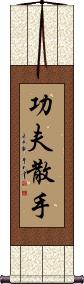
功夫散手 is a martial arts title.
Oddly, there are multiple ways two spell/romanize this in English, but in Chinese, it's written exactly the same.
Technically, the Mandarin romanizes as “gong fu san shou,” for which you'll sometimes see it written “kung fu san shou” (k'ung is an old romanization for a word that sounds like gong with a vowel sound like “oh”).
There is another martial arts style that spells this “Kung Fu San Soo.” I guess this was supposed to approximate Cantonese pronunciation for which the scholarly romanization is generally agreed to be “gung fu saan sau.”
Beauty / Beautiful / Handsome
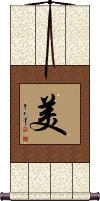
美 is often used to describe the beauty of a woman.
However, when applied to a man, it can mean handsome. It's also the first character in the word for “beauty salon” which you will see all over China and Japan.
This can be used as the given name for a girl (spell it or say it as “Mei” or “May”).
For a bit of trivia: The title for the “USA” in Chinese is “Mei Guo” which literally means “Beautiful Country.” This name was bestowed at a time before Chairman Mao came to power and decided that China didn't like the USA anymore (even though we fought together against the Japanese in WWII). But these days, Chinese people love Americans (but have a distaste for American politics and policy). But I digress...
美 is also how “Beautiful” is written in Japanese Kanji and Korean Hanja. 美 can also mean: very satisfactory; good; to be pleased with oneself; abbreviation for the USA; fine; handsome; admirable; madhura; sweet; and/or pleasant.
See Also: Beautiful Woman | Beautiful Girl
Geisha
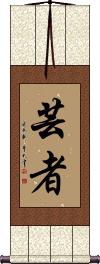
芸者 is the real basis for the way we spell geisha.
However, there are many more ways to refer to a woman that fills the role that westerners think of when they hear the word geisha.
In Japanese, these characters literally mean “artful person.” But in English, it might be better translated as “a person (woman) highly trained/accomplished in the arts.”
However, my Japanese dictionary says “a singing and dancing girl.”
Many will argue as to whether “geisha” = “prostitute” or not. My Japanese friends seem to have the opinion that a geisha is so highly trained in the art of playing musical instruments and dancing that the fact she might also be a prostitute is secondary to her performance on stage.
芸者 is a “Japanese only” term, they use a slightly different first character to express “geisha” in Chinese. Since this is a Japanese term, I have not included the Chinese version.
These search terms might be related to Spell:
A Moment of Time is as Precious as Gold
Do Not Fear the Task: Cooperation Will Lead to Success
Do Not Take Action Until the Time is Right
Each Time You Stumble and Fall, You Gain Experience and Wisdom
First Turn of the Dharma Wheel
In the Abyss of Infinite Bitterness - Turn to the Shore
Time
Time and Tide Wait for No Man
Time Heals All Wounds
Time is as Precious as Gold
Time is Gold
Time is Money
Time is More Valuable Than Jade
Time Waits for No One
Not the results for Spell that you were looking for?
Below are some entries from our dictionary that may match your Spell search...
| Characters If shown, 2nd row is Simp. Chinese |
Pronunciation Romanization |
Simple Dictionary Definition |
頓 顿 see styles |
dùn dun4 tun tomi とみ |
to stop; to pause; to arrange; to lay out; to kowtow; to stamp (one's foot); at once; classifier for meals, beatings, scoldings etc: time, bout, spell, meal (n,adj-nari) (1) (archaism) (See 頓に・とみに,頓と・とんと・1) sudden; abrupt; unexpected; (n,adj-nari) (2) (とん only) (archaism) stupid; foolish; (3) (とん only) {Buddh} attaining enlightenment in one effort (without ascetic practices, etc.); (surname) Tomi To fall headlong, prostrate; at one time, at once; suddenly; immediate; a pause; to stamp; make ready; used chiefly in contrast with 漸 gradually. |
魔法 see styles |
mó fǎ mo2 fa3 mo fa mahou / maho まほう |
More info & calligraphy: Magic(noun - becomes adjective with の) magic; witchcraft; sorcery; spell; (female given name) Maho |
呪 咒 see styles |
zhòu zhou4 chou ju じゅ |
variant of 咒[zhou4] (1) spell; curse; (2) (Buddhist term) dharani; mantra; (archaism) spell; curse (Skt. mantra) |
咒 see styles |
zhòu zhou4 chou ju じゅ |
incantation; magic spell; curse; malediction; to revile; to put a curse on sb (1) spell; curse; (2) (Buddhist term) dharani; mantra dhāraṇī 陀羅尼; mantra; an incantation, spell, oath, curse; also a vow with penalties for failure. Mystical, or magical, formulae employed in Yoga. In Lamaism they consist of sets of Tibetan words connected with Sanskrit syllables. In a wider sense dhāraṇī is a treatise with mystical meaning, or explaining it. |
唵 see styles |
ǎn an3 an on おん |
(interjection) oh!; (dialect) to stuff something in one's mouth; (used in buddhist transliterations) om (interjection) (See オーム) om (ritual chant in Hinduism, etc.); aum oṃ; auṃ; 'a word of solemn affirmation and respectful assent (sometimes translated by yes, verily, so be it, and in this sense compared with Amen). 'M. W. It is 'the mystic name for the Hindu triad', and has other significations. It was adopted by Buddhists, especially by the Tantric school, as a mystic spell, and as an object of meditation. It forms the first syllable of certain mystical combinations, e. g. 唵?呢叭 061971 吽 oṃ maṇi padme huṃ, which is a formula of the Lamaistic branch, said to be a prayer to Padmapani; each of the six syllables having its own mystic power of salvation from the lower paths of transmigration, etc.; the formula is used in sorcery, auguries, etc.; other forms of it are 唵?呢鉢頭迷吽; 唵麽抳鉢訥銘吽. |
拼 see styles |
pīn pin1 p`in pin |
to piece together; to put together; to pool (resources etc); to share; to risk all; to go all out; to spell (words) |
蠱 蛊 see styles |
gǔ gu3 ku maji まじ |
arch. legendary venomous insect; to poison; to bewitch; to drive to insanity; to harm by witchcraft; intestinal parasite (1) (archaism) (See 蠱物) charmed and cursed; (2) something that bewilders; something that leads one astray; the work of demons spell |
陣 阵 see styles |
zhèn zhen4 chen noburu のぶる |
disposition of troops; wave; spate; burst; spell; short period of time; classifier for events or states of short duration (1) (See 背水の陣) battle formation; (2) (See 陣を張る) camp; encampment; position; (n,n-suf) (3) (See 報道陣) group; gang; party; corps; (4) (See 大坂夏の陣) war; battle; campaign; (given name) Noburu a file of soldiers |
霖 see styles |
lín lin2 lin rin りん |
continued rain long spell of rain; (female given name) Rin |
一陣 一阵 see styles |
yī zhèn yi1 zhen4 i chen ichijin いちじん |
a burst; a fit; a peal; a spell (period of time) (1) gust of wind; (2) vanguard; (surname) Ichijin |
呪い see styles |
majinai まじない |
(kana only) charm; incantation; spell; curse |
呪う see styles |
majinau まじなう |
(Godan verb with "u" ending) (1) (kana only) to pray that one avoids disaster or illness; (Godan verb with "u" ending) (2) (kana only) to pray for harm or death to come upon someone; to curse; (Godan verb with "u" ending) (3) (kana only) (See まじない) to charm; to conjure; to cast a spell (on someone); (Godan verb with "u" ending) (4) (archaism) to treat illness (with a prayer) |
呪り see styles |
kashiri かしり |
(archaism) spell; curse |
呪文 see styles |
jumon じゅもん |
spell; charm; incantation; magic word |
呪縛 see styles |
jubaku じゅばく |
(noun, transitive verb) spell (that restricts one's movements); binding spell |
呪言 see styles |
zhòu yán zhou4 yan2 chou yen jugon; jugen じゅごん; じゅげん |
spell; curse; incantation a spell |
咒い see styles |
majinai まじない |
(out-dated kanji) (kana only) charm; incantation; spell; curse |
咒心 see styles |
zhòu xīn zhou4 xin1 chou hsin jushin |
The heart of a spell, or vow. |
咒文 see styles |
zhòu wén zhou4 wen2 chou wen jumon |
incantation; spell; to curse magic formulae |
咒語 咒语 see styles |
zhòu yǔ zhou4 yu3 chou yü |
incantation; spell; enchantment; curse |
密咒 see styles |
mì zhòu mi4 zhou4 mi chou mitsuju |
A dhāraṇī, or esoteric incantation. |
密號 密号 see styles |
mì hào mi4 hao4 mi hao mitsugō |
The esoteric name of Vairocana; also any 'true word' (Shingon) or esoteric spell. |
小康 see styles |
xiǎo kāng xiao3 kang1 hsiao k`ang hsiao kang shoukou / shoko しょうこう |
moderately affluent; well-off; a period of peace and prosperity (1) lull; breathing spell; respite; (2) remission (of an illness); becoming stable |
干魃 see styles |
kanbatsu かんばつ |
drought; long spell (period) of dry weather |
念咒 see styles |
niàn zhòu nian4 zhou4 nien chou |
to chant a magic spell; to recite incantations |
念誦 念诵 see styles |
niàn sòng nian4 song4 nien sung nenju ねんじゅ |
to read out; to recite; to remember sb (while talking about something else) (noun, transitive verb) {Buddh} invocation To recite, repeat, intone, e. g. the name of a Buddha; to recite a dhāraṇī, or spell. |
拼字 see styles |
pīn zì pin1 zi4 p`in tzu pin tzu |
to spell; spelling |
拼寫 拼写 see styles |
pīn xiě pin1 xie3 p`in hsieh pin hsieh |
to spell |
持明 see styles |
chí míng chi2 ming2 ch`ih ming chih ming jimei / jime じめい |
(surname) Jimei The dhāraṇī illuminant, i. e. the effective 'true word' or magical term. |
旱魃 see styles |
hàn bá han4 ba2 han pa kanbatsu かんばつ |
drought demon drought; long spell (period) of dry weather |
Click here for more Spell results from our dictionary
The following table may be helpful for those studying Chinese or Japanese...
| Title | Characters | Romaji (Romanized Japanese) | Various forms of Romanized Chinese | |
| Spell | 斯佩爾 斯佩尔 | sī pèi ěr si1 pei4 er3 si pei er sipeier | ssu p`ei erh ssupeierh ssu pei erh |
|
| Spell | スペル | superu | ||
| Nevaeh | 內瓦艾 内瓦艾 | nèi wǎ ài nei4 wa3 ai4 nei wa ai neiwaai | ||
| Kung Fu San Soo San Shou | 功夫散手 | gōng fu sǎn shǒu gong1 fu san3 shou3 gong fu san shou gongfusanshou | kung fu san shou kungfusanshou |
|
| Beauty Beautiful Handsome | 美 | bi | měi / mei3 / mei | |
| Geisha | 芸者 | geisha | yún zhě / yun2 zhe3 / yun zhe / yunzhe | yün che / yünche |
| In some entries above you will see that characters have different versions above and below a line. In these cases, the characters above the line are Traditional Chinese, while the ones below are Simplified Chinese. | ||||

Successful Chinese Character and Japanese Kanji calligraphy searches within the last few hours...



