Many custom options...


And formats...



Not what you want?
Try other similar-meaning words, fewer words, or just one word.
Never Stop in Chinese / Japanese...
Buy a Never Stop calligraphy wall scroll here!
Personalize your custom “Never Stop” project by clicking the button next to your favorite “Never Stop” title below...
1. Fear not long roads; Fear only short ambition
2. Police / Public Security Bureau
3. Law of the Fist Karate / Kempo Karate
Fear not long roads; Fear only short ambition
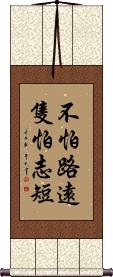
不怕路遠隻怕志短 is a Chinese proverb that literally translates as “Fear not long roads; fear only short ambition,” or “Don't fear that the road is long, only fear that your will/ambition/aspiration is short.”
Figuratively, this means: However difficult the goal is, one can achieve it as long as one is determined to do so.
Others may translate the meaning as “Don't let a lack of willpower stop you from pressing onward in your journey.”
Police / Public Security Bureau
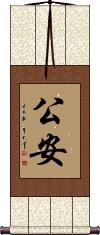
公安 is the Chinese, Japanese Kanji, and old Korean Hanja title for (The Ministry of) Public Security. 公安 can also generally mean public safety, public security, or public welfare. It is a positive term in Japan, where some even name their daughters “Kouan” (this title).
In China, this is the kinder name for the PSB or Public Security Bureau. It's really the national police of China - occasionally brutal and seldom properly-trained or educated. Once in a while, you find a PSB officer who lives up to the title of 公安. Before the 1989 massacre, it was the PSB officers who refused to stop nor kill any of the protesting college students (so they're not all bad). The Chinese government had to call in soldiers from Inner Mongolia to kill thousands of protesters.
Law of the Fist Karate / Kempo Karate
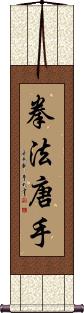
The first two characters mean “fist law” which is Romanized from Japanese as “Kenpo” or “Kempo.”
The last two are a secondary way to express “karate.”
Notes:
The more common way to express “karate” is literally “empty hand” (meaning “without weapons in your hand”). This version would be translated literally as “Tang hand” (as in the Tang Dynasty) or “China hand” (sometimes “Tang” means “China” in Japanese). Even though the character for “Tang” is used instead of “empty,” it's still pronounced “kara-te” in Japanese.
拳法唐手 is not commonly used in China - so please consider it to be a Japanese-only title.
Many Japanese people will say the last two Kanji are the old and antiquated way of saying Karate. This fact does not stop this title from existing, as these four characters are often seen in Kenpo / Kempo Dojos around the western world.
Mountain Travels Poem by Dumu

This poem was written almost 1200 years ago during the Tang dynasty.
It depicts traveling up a place known as Cold Mountain, where some hearty people have built their homes. The traveler is overwhelmed by the beauty of the turning leaves of the maple forest that surrounds him just as night overtakes the day, and darkness prevails. His heart implores him to stop, and take in all of the beauty around him.
First, before you get to the full translation, I must tell you that Chinese poetry is a lot different than what we have in the west. Chinese words simply don't rhyme in the same way that English or other western languages do. Chinese poetry depends on rhythm and a certain beat of repeated numbers of characters.
I have done my best to translate this poem keeping a certain feel of the original poet. But some of the original beauty of the poem in its original Chinese will be lost in translation.
Far away on Cold Mountain, a stone path leads upwards.
Among white clouds, people's homes reside.
Stopping my carriage I must, as to admire the maple forest at nights fall.
In awe of autumn leaves showing more red than even flowers of early spring.
Hopefully, this poem will remind you to stop, and “take it all in” as you travel through life.
The poet's name is “Du Mu” in Chinese that is: 
 .
.
The title of the poem, “Mountain Travels” is: 

You can have the title, poet's name, and even “Tang Dynasty” written as an inscription on your custom wall scroll if you like.
More about the poet:
Dumu lived from 803-852 AD and was a leading Chinese poet during the later part of the Tang dynasty.
He was born in Chang'an, a city in central China and the former capital of the ancient Chinese empire in 221-206 BC. In present-day China, his birthplace is currently known as Xi'an, the home of the Terracotta Soldiers.
He was awarded his Jinshi degree (an exam administered by the emperor's court which leads to becoming an official of the court) at the age of 25 and went on to hold many official positions over the years. However, he never achieved a high rank, apparently because of some disputes between various factions, and his family's criticism of the government. His last post in the court was his appointment to the office of Secretariat Drafter.
During his life, he wrote scores of narrative poems, as well as a commentary on the Art of War and many letters of advice to high officials.
His poems were often very realistic and often depicted everyday life. He wrote poems about everything, from drinking beer in a tavern to weepy poems about lost love.
The thing that strikes you most is the fact even after 1200 years, not much has changed about the beauty of nature, toils, and troubles of love and beer drinking.
Broken Mirror Rejoined
Used in modern times for divorced couples that come back together
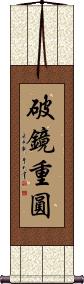
破鏡重圓 is about a husband and wife who were separated and reunited.
About 1500 years ago in China, there lived a beautiful princess named Le Chang. She and her husband Xu De Yan loved each other very much. But when the army of the Sui Dynasty was about to attack their kingdom, disposed of all of their worldly possessions and prepared to flee into exile.
They knew that in the chaos, they might lose track of each other, so the one possession they kept was a bronze mirror which is a symbol of unity for a husband and wife. They broke the mirror into two pieces, and each of them kept half of the mirror. They decided that if separated, they would try to meet at the fair during the 15th day of the first lunar month (which is the lantern festival). Unfortunately, the occupation was brutal, and the princess was forced to become the mistress of the new commissioner of the territory, Yang Su.
At the Lantern Festival the next year, the husband came to the fair to search for his wife. He carried with him his half of the mirror. As he walked through the fair, he saw the other half of the mirror for sale at a junk market by a servant of the commissioner. The husband recognized his wife's half of the mirror immediately, and tears rolled down his face as he was told by the servant about the bitter and loveless life that the princess had endured.
As his tears dripped onto the mirror, the husband scratched a poem into his wife's half of the mirror:
You left me with the severed mirror,
The mirror has returned, but absent are you,
As I gaze in the mirror, I seek your face,
I see the moon, but as for you, I see not a trace.
The servant brought the inscribed half of the mirror back to the princess. For many days, the princess could not stop crying when she found that her husband was alive and still loved her.
Commissioner Yang Su, becoming aware of this saga, realized that he could never obtain the princess's love. He sent for the husband and allowed them to reunite.
This proverb, 破鏡重圓, is now used to describe a couple who has been torn apart for some reason (usually divorce) but have come back together (or remarried).
It seems to be more common these days in America for divorced couples to reconcile and get married to each other again. This will be a great gift if you know someone who is about to remarry their ex.
Undaunted After Repeated Setbacks
Persistence to overcome all challenges
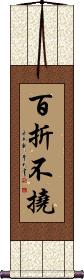
百折不撓 is a Chinese proverb that means “Be undaunted in the face of repeated setbacks.”
More directly translated, it reads, “[Overcome] a hundred setbacks, without flinching.” 百折不撓 is of Chinese origin but is commonly used in Japanese and somewhat in Korean (same characters, different pronunciation).
This proverb comes from a long, and occasionally tragic story of a man that lived sometime around 25-220 AD. His name was Qiao Xuan, and he never stooped to flattery but remained an upright person at all times. He fought to expose the corruption of higher-level government officials at great risk to himself.
Then when he was at a higher level in the Imperial Court, bandits were regularly capturing hostages and demanding ransoms. But when his own son was captured, he was so focused on his duty to the Emperor and the common good that he sent a platoon of soldiers to raid the bandits' hideout, and stop them once and for all even at the risk of his own son's life. While all of the bandits were arrested in the raid, they killed Qiao Xuan's son at first sight of the raiding soldiers.
Near the end of his career, a new Emperor came to power, and Qiao Xuan reported to him that one of his ministers was bullying the people and extorting money from them. The new Emperor refused to listen to Qiao Xuan and even promoted the corrupt Minister. Qiao Xuan was so disgusted that in protest, he resigned from his post as minister (something almost never done) and left for his home village.
His tombstone reads “Bai Zhe Bu Nao” which is now a proverb used in Chinese culture to describe a person of strong will who puts up stubborn resistance against great odds.
My Chinese-English dictionary defines these 4 characters as “keep on fighting despite all setbacks,” “be undaunted by repeated setbacks,” and “be indomitable.”
Our translator says it can mean “never give up” in modern Chinese.
Although the first two characters are translated correctly as “repeated setbacks,” the literal meaning is “100 setbacks” or “a rope that breaks 100 times.” The last two characters can mean “do not yield” or “do not give up.”
Most Chinese, Japanese, and Korean people will not take this absolutely literal meaning but will instead understand it as the title suggests above. If you want a single big word definition, it would be indefatigability, indomitableness, persistence, or unyielding.
See Also: Tenacity | Fortitude | Strength | Perseverance | Persistence
Not the results for never stop that you were looking for?
Below are some entries from our dictionary that may match your never stop search...
| Characters If shown, 2nd row is Simp. Chinese |
Pronunciation Romanization |
Simple Dictionary Definition |
〇 see styles |
líng ling2 ling maru まる |
More info & calligraphy: Enso - Japanese Zen Circle(1) circle (sometimes used for zero); (2) 'correct' (when marking); (3) symbol used as a placeholder (either because a number of other words could be used in that position, or because of censorship); (4) period; full stop; (5) maru mark; semivoiced sound; p-sound |
讀 读 see styles |
dú du2 tu doku |
More info & calligraphy: Read / StudyTo read; a comma, full stop. |
頓 顿 see styles |
dùn dun4 tun tomi とみ |
More info & calligraphy: Dayton(n,adj-nari) (1) (archaism) (See 頓に・とみに,頓と・とんと・1) sudden; abrupt; unexpected; (n,adj-nari) (2) (とん only) (archaism) stupid; foolish; (3) (とん only) {Buddh} attaining enlightenment in one effort (without ascetic practices, etc.); (surname) Tomi To fall headlong, prostrate; at one time, at once; suddenly; immediate; a pause; to stamp; make ready; used chiefly in contrast with 漸 gradually. |
休 see styles |
xiū xiu1 hsiu yasumu やすむ |
to rest; to stop doing something for a period of time; to cease; (imperative) don't (personal name) Yasumu Desist, give up; resign; divorce; blessing, favour. |
住 see styles |
zhù zhu4 chu munetsugu むねつぐ |
to live; to dwell; to stay; to reside; to stop; (suffix indicating firmness, steadiness, or coming to a halt) dwelling; living; (personal name) Munetsugu sthiti. To abide, dwell, stay, stop, settle. |
偃 see styles |
yǎn yan3 yen |
to lie supine; to stop; to fall down |
停 see styles |
tíng ting2 t`ing ting chō |
to stop; to halt; to park (a car) To stop, rest, settle, delay. |
儅 see styles |
dāng dang1 tang |
stop |
堨 see styles |
è e4 o |
dam; to stop; check |
堵 see styles |
dǔ du3 tu to と |
to block up (a road, pipe etc); to stop up (a hole); (fig.) (of a person) choked up with anxiety or stress; wall (literary); (classifier for walls) (rare) fence; wall; hedge |
塞 see styles |
sè se4 se sai |
(bound form) to block; to obstruct To stop up, block, gag; dull; honest; a barrier, frontier; translit. s. |
壅 see styles |
yōng yong1 yung |
to obstruct; to stop up; to heap soil around the roots of a plant |
寢 寝 see styles |
qǐn qin3 ch`in chin shin |
(bound form) to lie down to sleep or rest; (bound form) bedroom; (bound form) imperial tomb; (literary) to stop; to cease To sleep, rest; stop; a retiring room, resting place. |
寧 宁 see styles |
nìng ning4 ning yasushi やすし |
would rather; to prefer; how (emphatic); Taiwan pr. [ning2] (irregular okurigana usage) (adverb) (kana only) rather; better; instead; (given name) Yasushi Repose; settle; better than; rather; how? |
尼 see styles |
ní ni2 ni ni に |
Buddhist nun; (often used in phonetic spellings) (n,n-suf) (1) (abbreviation) {Buddh} (See 比丘尼・1) bhikkhuni (fully ordained nun); (2) (abbreviation) (See 印度尼西亜・インドネシア) Indonesia; (given name) Ni To stop; a nun; near; translit. ni. When used for a nun it is an abbrev. for 比丘尼 bhikṣuṇī. |
已 see styles |
yǐ yi3 i i |
already; to stop; then; afterwards Already, past; end, cease. |
弭 see styles |
mǐ mi3 mi mi はず |
to stop; repress (1) (kana only) expectation that something took place, will take place or was in some state; it should be so; bound to be; expected to be; must be; (2) nock (of a bow); (3) nock (of an arrow); (4) (sumo) nock-shaped grip (between thumb and forefinger); (5) wooden frame on the tip of the mast of a Japanese ship that prevents the hawser from falling out Stop, put down. |
彌 弥 see styles |
mí mi2 mi wataru わたる |
full; to fill; completely; more (given name) Wataru To shoot, reach everywhere, pervade; complete, universal; prevent, stop; more; long. |
息 see styles |
xī xi1 hsi yasumu やすむ |
breath; news; interest (on an investment or loan); to cease; to stop; to rest; Taiwan pr. [xi2] (form) son; (personal name) Yasumu To breathe; breath; rest, stop, settle, cease; produce, interest. |
戒 see styles |
jiè jie4 chieh kai; ingoto(ok) かい; いんごと(ok) |
to guard against; to exhort; to admonish or warn; to give up or stop doing something; Buddhist monastic discipline; ring (for a finger) (1) (かい only) {Buddh} admonition; commandment; (2) sila (precept) śīla, 尸羅. Precept, command, prohibition, discipline, rule; morality. It is applied to the five, eight, ten, 250, and other commandments. The five are: (1) not to kill; (2 ) not to steal; (3) not to commit adultery; (4) not to speak falsely; (5) not to drink wine. These are the commands for lay disciples; those who observe them will be reborn in the human realm. The Sarvāstivādins did not sanction the observance of a limited selection from them as did the 成實宗 Satyasiddhi school. Each of the five precepts has five guardian spirits, in all twenty-five, 五戒二十五神. The eight for lay disciples are the above five together with Nos. 7, 8, and 9 of the following; the ten commands for the ordained, monks and nuns, are the above five with the following: (6) not to use adornments of flowers, nor perfumes; (7) not to perform as an actor, juggler, acrobat, or go to watch and hear them; (8) not to sit on elevated, broad, and large divans (or beds); (9) not to eat except in regulation hours; (10) not to possess money, gold or silver, or precious things. The 具足戒full commands for a monk number 250, those for a nun are 348, commonly called 500. Śīla is also the first of the 五分法身, i.e. a condition above all moral error. The Sutra of Brahma's Net has the following after the first five: (6) not to speak of the sins of those in orders; (7) not to vaunt self and depreciate others; (8) not to be avaricious; (9) not to be angry; (10) not to slander the triratna. |
截 see styles |
jié jie2 chieh setsu |
to cut off (a length); to stop; to intercept; section; chunk; length To cut off, intercept. |
抑 see styles |
yì yi4 i somo そも |
to restrain; to restrict; to keep down; or (conjunction) (kana only) (dated) (used when bringing up something already mentioned) (See そもそも・2) after all; anyway; actually; well, ...; ... on earth (e.g. "what on earth?"); ... in the world (e.g. "why in the world?") Curb, repress; or. |
拫 see styles |
hén hen2 hen |
to pull; to drag; to stop |
收 see styles |
shōu shou1 shou teruo てるお |
to receive; to accept; to collect; to put away; to restrain; to stop; in care of (used on address line after name) (personal name) Teruo To receive; collect, gather; withdraw. |
杜 see styles |
dù du4 tu mori もり |
birchleaf pear (tree); to stop; to prevent; to restrict (1) forest; (2) shrine grove; (surname, female given name) Mori Stop, prevent; azalea. |
板 see styles |
bǎn ban3 pan ban ばん |
board; plank; plate; shutter; table tennis bat; clappers (music); CL:塊|块[kuai4]; accented beat in Chinese music; hard; stiff; to stop smiling or look serious (1) board; plank; (2) sheet (of metal); plate (of glass); pane; slab; (3) (See 俎板・1) cutting board; chopping board; (4) (abbreviation) (usu. as 板さん) (See 板前・1,板場・いたば・2) chef (esp. of high-end Japanese cuisine); cook; (5) stage (i.e. at a theatre); (personal name) Ban A board; a board struck for calling e. g. to meals. |
柅 see styles |
nǐ ni3 ni |
(tree); to stop |
栽 see styles |
zāi zai1 tsai sai さい |
to plant; to grow; to insert; to erect (e.g. a bus stop sign); to impose something on sb; to stumble; to fall down (surname) Sai |
歇 see styles |
xiē xie1 hsieh |
to rest; to take a break; to stop; to halt; (dialect) to sleep; a moment; a short while |
止 see styles |
zhǐ zhi3 chih tomeru とめる |
to stop; to prohibit; until; only (given name) Tomeru To stop, halt, cease; one of the seven definitions of 禪定 dhyāna described as 奢摩他 śamatha or 三摩地 samādhi; it is defined as 靜息動心 silencing, or putting to rest the active mind, or auto-hypnosis; also 心定止於一處 the mind centred, lit. the mind steadily fixed on one place, or in one position. It differs from 觀 which observes, examines, sifts evidence; 止 has to do with 拂妄 getting rid of distraction for moral ends; it is abstraction, rather than contemplation; see 止觀 In practice there are three methods of attaining such abstraction: (a) by fixing the mind on the nose, navel, etc.; (b) by stopping every thought as it arises; (c) by dwelling on the thought that nothing exists of itself, but from a preceding cause. |
Click here for more never stop results from our dictionary
The following table may be helpful for those studying Chinese or Japanese...
| Title | Characters | Romaji (Romanized Japanese) | Various forms of Romanized Chinese | |
| Fear not long roads; Fear only short ambition | 不怕路遠隻怕志短 不怕路远只怕志短 | bú pà lù yuǎn zhǐ pà zhì duǎn bu2 pa4 lu4 yuan3 zhi3 pa4 zhi4 duan3 bu pa lu yuan zhi pa zhi duan bupaluyuanzhipazhiduan | pu p`a lu yüan chih p`a chih tuan pu pa lu yüan chih pa chih tuan |
|
| Police Public Security Bureau | 公安 | kou an / kouan / ko an | gōng ān / gong1 an1 / gong an / gongan | kung an / kungan |
| Law of the Fist Karate Kempo Karate | 拳法唐手 | ken pou kara te kenpoukarate ken po kara te | quán fǎ táng shǒu quan2 fa3 tang2 shou3 quan fa tang shou quanfatangshou | ch`üan fa t`ang shou chüanfatangshou chüan fa tang shou |
| Mountain Travels Poem by Dumu | 遠上寒山石徑斜白雲生處有人家停車坐愛楓林晚霜葉紅於二月花 远上寒山石径斜白云生处有人家停车坐爱枫林晚霜叶红于二月花 | yuǎn shàng hán shān shí jìng xiá bái yún shēng chù yǒu rén jiā tíng chē zuò ài fēng lín wǎn shuàng yè hóng yú èr yuè huā yuan3 shang4 han2 shan1 shi2 jing4 xia2 bai2 yun2 sheng1 chu4 you3 ren2 jia1 ting2 che1 zuo4 ai4 feng1 lin2 wan3 shuang4 ye4 hong2 yu2 er4 yue4 hua1 yuan shang han shan shi jing xia bai yun sheng chu you ren jia ting che zuo ai feng lin wan shuang ye hong yu er yue hua | yüan shang han shan shih ching hsia pai yün sheng ch`u yu jen chia t`ing ch`e tso ai feng lin wan shuang yeh hung yü erh yüeh hua yüan shang han shan shih ching hsia pai yün sheng chu yu jen chia ting che tso ai feng lin wan shuang yeh hung yü erh yüeh hua |
|
| Broken Mirror Rejoined | 破鏡重圓 破镜重圆 | pò jìng chóng yuán po4 jing4 chong2 yuan2 po jing chong yuan pojingchongyuan | p`o ching ch`ung yüan pochingchungyüan po ching chung yüan |
|
| Undaunted After Repeated Setbacks | 百折不撓 百折不挠 | hyaku setsu su tou hyakusetsusutou hyaku setsu su to | bǎi zhé bù náo bai3 zhe2 bu4 nao2 bai zhe bu nao baizhebunao | pai che pu nao paichepunao |
| In some entries above you will see that characters have different versions above and below a line. In these cases, the characters above the line are Traditional Chinese, while the ones below are Simplified Chinese. | ||||

Successful Chinese Character and Japanese Kanji calligraphy searches within the last few hours...



