Many custom options...


And formats...



Not what you want?
Try other similar-meaning words, fewer words, or just one word.
Bound Together in Chinese / Japanese...
Buy a Bound Together calligraphy wall scroll here!
Personalize your custom “Bound Together” project by clicking the button next to your favorite “Bound Together” title below...
1. Infinity / Infinite / Unlimited / Unbounded
7. Relationship
9. No Surrender
10. Courage to do what is right
12. Fundamental Principles of Tai Chi Chuan
13. An Open Book Benefits Your Mind
14. A Bright Future
15. Guanxi
Infinity / Infinite / Unlimited / Unbounded
Japanese = Infinity / Chinese = No limits
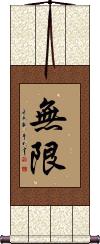
無限 is the Chinese and Japanese word meaning infinity, unlimited or unbounded.
無限 literally translates as “without limits” or “without [being] bound.”
The first character means “never” or “not,” like the prefix “un-.”
The second means “limited,” “restricted,” or “bound.”
Please note that the Japanese definition leans more toward “infinity” and the Chinese is more about being “boundless” or “without limits.”
In Korean, this means infinity, infinitude, or boundlessness. But in Korean, this term has many interpretations or contexts, so your intended meaning might be vague or ambiguous.
Strong / Robust
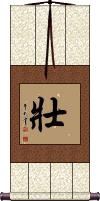
This “strong” character means “to strengthen” or robust. This brings images of a muscle-bound hulk of a weight lifter or bodybuilder to an Asian person who sees this character.
Note that in Korean and Japanese, this character is normally part of compound words, and is not seen alone too often.
 Note that the this character was simplified in Japan after WWII (also simplified in mainland China but not for calligraphy). If you want the modern Japanese/simplified version, please click on the Kanji shown to the right.
Infinite Love
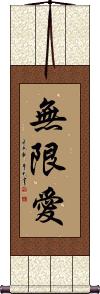
無限愛 is the Chinese and Japanese title meaning infinite love, unlimited love, or unbounded love.
The first character means never, not, or like the prefix “un-.”
The second means limited, restricted, or bound.
The third means love or affection.
Heaven Rewards Hard Work
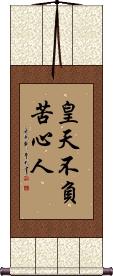
皇天不负苦心人 is an inspirational Chinese proverb that can be translated in a few ways:
Heaven will not disappoint the person who tries.
If you try hard, you're bound to succeed eventually.
Heaven rewards diligent work.
Sincere/heartful effort reaps the grace of Heaven.
Greatest Infinite Love
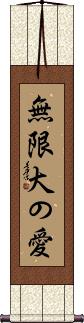
無限大の愛 is a Japanese title meaning infinite great love, unlimited great love, or eternal love.
無 means never, not, or like a prefix “un-.”
限 means limited, restricted, or bound.
大 means great or big.
の is a possessive article.
愛 means love or affection.
Pride Goes Before a Fall
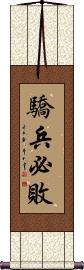
This literally means an arrogant army is bound to lose.
The meaning is similar to “pride goes before a fall.”
Others may translate this as “defeat is inevitable for an overconfident army,” “being arrogant and overconfident inevitably leads to defeat,” or “pride comes before a fall.”
Relationship
Most common Japanese version
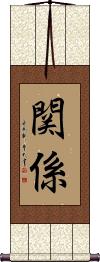
The dictionary definition is:
relation, relationship, connection, participation, involvement, concern, influence, effect, related to, connected to, or as a suffix to sexual it can mean sexual relations or relationship.
But there's more to it...
In Japan, the relationship that you have with certain people can open doors for you. Having this relationship with someone also means they would never rip you off but instead are honor-bound to treat you fairly.
See our Chinese Guanxi entry for more information. This term is used in very similar ways in China, Japan, and Korea.
See Also: Guanxi
Eternal Life / Future Life
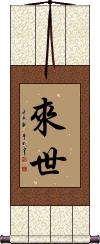
來世 is a word that can be used in many different ways.
It is often used to express the next life (life in heaven or wherever your soul is bound for). So it does have a religious overtone. However, it can also be used to express your life in the future - perhaps during your present lifetime.
It can also be translated as “the next world,” “the next generation,” “the time that is to come,” “otherworld,” or simply “posterity.”
See Also: Eternity | Rebirth | Reincarnation | Immortality
No Surrender
Honor Does Not Allow Second Thoughts
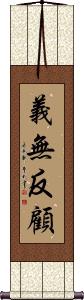
義無反顧 is a Chinese proverb that can be translated in a few different ways. Here are some examples:
Honor does not allow one to glance back.
Duty-bound not to turn back.
No surrender.
To pursue justice with no second thoughts.
Never surrender your principles.
This proverb is about the courage to do what is right without questioning your decision to take the right and just course.
Courage to do what is right
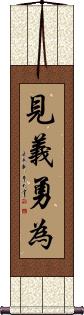
見義勇為 means the courage to do what is right in Chinese.
This could also be translated as “Never hesitate to do what is right.”
This comes from Confucian thought:
Your courage should head in an honorable direction. For example, you should take action when the goal is to attain a just result as, without honorable intent, a person’s gutsy fervor can easily lead them astray.
One who flaunts courage but disregards justice is bound to do wrong; someone who possesses courage and morality is destined to become a hero.
Some text above paraphrased from The World of Chinese - The Character of 勇
See Also: Work Unselfishly for the Common Good | Justice | Bravery
Love Binds Us Together
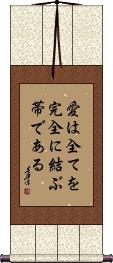
愛は全てを完全に結ぶ帯である is a Japanese phrase that suggests we (or a couple) are bound together by love.
I searched the web and found all of these English translation variations for this phrase:
Have love; The only way in which you may be completely joined together.
Love is the sash that perfectly binds us together.
Love is what binds us together
Love binds all things together in perfect unity.
This same Japanese phrase is used as part of Colossians 3:14 in at least one version of the Japanese Bible.
A few Biblical versions include:
...Charity, which is the bond of perfectness. (KJV)
...Love, which binds them all together in perfect unity. (NIV)
Note: Because this selection contains some special Japanese Hiragana characters, it should be written by a Japanese calligrapher.
Fundamental Principles of Tai Chi Chuan
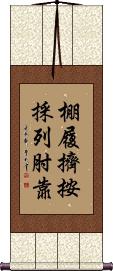
Peng, Lu, Ji, An, Cai, Lie, Zhou, and Kao are the eight fundamentals or forces of Tai Chi Chuan or Taiqiquan.
棚 (Peng) refers to the outward (or upward) expansion of energy.
履 (Lu) is often referred to as “rollback.” Lu is the ability to absorb, yield/deflect incoming force.
擠 (Ji) is often thought of as a “forward press.” However, it is also best described as a “squeezing out of space.”
按 (An) is a downward movement of energy, best translated as “(relaxed) sinking.”
採 (Cai or Tsai) translated as “downward pluck.” Cai is a combination of Lu and An.
列 (Lie or Lieh) is “Split” and is a combination of Peng and Ji.
肘 (Zhou) Elbowing.
靠 (Kao) Shouldering (for when the arms are bound/distance is too close to punch).
Source: https://combativecorner.wordpress.com/2015/12/03/the-8-energies-and-5-movements-of-taijiquan/
An Open Book Benefits Your Mind
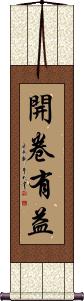
There are several ways to translate this ancient proverb. Translated literally and directly, it says, “Open roll has/yields benefit.”
To understand that, you must know a few things...
First, Chinese characters and language have deeper meanings that often are not spoken but are understood - especially with ancient texts like this. Example: It's understood that the “benefit” referred to in this proverb is to the reader's mind. Just the last character expresses that whole idea.
Second, Chinese proverbs are supposed to make you think and leave a bit of mystery to figure out.
Third, for this proverb, it should be noted that roll = book. When this proverb came about (about two thousand years ago), books were rolls of bamboo slips strung together. The first bound books like the ones we use today did not come about until about a thousand years after this proverb when they invented paper in China.
開卷有益 is a great gift for a bookworm who loves to read and increase their knowledge. Or for any friend that is or wants to be well-read.
Some other translations of this phrase:
Opening a book is profitable
The benefits of education.
A Bright Future
Incredible 10,000-Mile Flight of the Peng
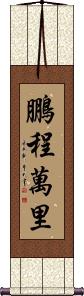
鵬程萬里 is an ancient Chinese proverb used in modern times to wish someone a long and successful career.
It's really about the 10,000 Flight of the Peng (Peng, also known as Roc is a mythical fish that can turn into a bird and take flight).
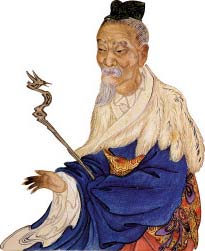
莊子
Zhuangzi or Chuang Tzu
Breaking down each character:
1. Peng or Roc (a kind of bird).
2. Journey (in this case, a flight).
3. 10,000 (Ten Thousand).
4. Li is a unit of distance often referred to as a “Chinese Mile,” though the real distance is about half a kilometer.
Direct Translation: “Peng's Journey [of] 10,000 Li.”
Literal meaning: “The 10,000-Li Flying Range Of The Roc.”
Perceived meaning: “To have a bright future” or “To go far.”
This proverb/idiom comes from the book of Zhuangzi or Chuang Tzu. It tells the tale of a huge fish that could turn into a gigantic bird. This bird was called a “peng” and was many miles long. This legendary size allowed the Peng to fly from the Northern Sea to the Southern Sea in a single bound.
Wishing someone “a Peng's Journey of 10,000 Li” will imply that they can travel far without stopping and will have great success, a long career, and a prosperous future.
Guanxi
The Chinese Concept of Relationship and Exchange of Favors
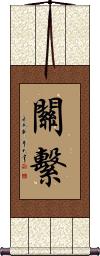
The dictionary definition is:
Relations/relationship, to concern, to affect, to have to do with, or connection.
But there's more to it...
In China, the relationship that you have with certain people can open doors for you. Having guanxi with someone also means they would never defraud you but are honor-bound to treat you fairly (of course, this goes both ways). Sometimes it is suggested that guanxi is the exchange of favors. 關繫 / 関繫 / 關係 is more about having a relationship that allows you to ask for and expect favors without shame.
There is no concept in western culture that exactly matches guanxi, but perhaps having a social or professional network is similar.
Note that there are some variations common within Chinese, Japanese Kanji, and Korean Hanja for this word... Japanese tend to use a Chinese alternate form as shown to the right for
the first character.
 There's also another alternate form of that first character (currently used as the official Simplified form in mainland China) which looks like the character shown to the right. It's basically the central radical of the alternate version shown above but without the “door radical” around it. In more free-flowing calligraphy styles, this version would be the likely choice for a calligrapher.
 In Modern Japanese, they use the character shown to the right.
They also tend to use this same form in Korean Hanja (I've only checked this word in my Korean dictionary, but it has not been confirmed by a translator's review).
 If that was not confusing enough, there is another alternate form of that second character. See right.
An Asian calligrapher of any nationality may use these forms at their discretion. However, They would tend to stick to the most common form used in their respective languages.
If you have any preference on any of these issues, please give us a special note with your order, and we'll make sure it's done the way you want.
The following table may be helpful for those studying Chinese or Japanese...
| Title | Characters | Romaji (Romanized Japanese) | Various forms of Romanized Chinese | |
| Infinity Infinite Unlimited Unbounded | 無限 无限 | mu gen / mugen | wú xiàn / wu2 xian4 / wu xian / wuxian | wu hsien / wuhsien |
| Strong Robust | 壯 壮 | sou / so | zhuàng / zhuang4 / zhuang | chuang |
| Infinite Love | 無限愛 无限爱 | mu gen ai / mugenai | wú xiàn ài wu2 xian4 ai4 wu xian ai wuxianai | wu hsien ai wuhsienai |
| Heaven Rewards Hard Work | 皇天不負苦心人 皇天不负苦心人 | huáng tiān bù fù kǔ xīn rén huang2 tian1 bu4 fu4 ku3 xin1 ren2 huang tian bu fu ku xin ren huangtianbufukuxinren | huang t`ien pu fu k`u hsin jen huangtienpufukuhsinjen huang tien pu fu ku hsin jen |
|
| Greatest Infinite Love | 無限大の愛 | bu gen dai no ai bugendainoai | ||
| Pride Goes Before a Fall | 驕兵必敗 骄兵必败 | kyouheihippai / kyohehippai kyoheihipai / kyohehipai | jiāo bīng bì bài jiao1 bing1 bi4 bai4 jiao bing bi bai jiaobingbibai | chiao ping pi pai chiaopingpipai |
| Relationship | 關繫 / 関繫 / 關係 関係 | kan kei / kankei | guān xì / guan1 xi4 / guan xi / guanxi | kuan hsi / kuanhsi |
| Eternal Life Future Life | 來世 来世 | rai-se | lái shì / lai2 shi4 / lai shi / laishi | lai shih / laishih |
| No Surrender | 義無反顧 义无反顾 | yì wú fǎn gù yi4 wu2 fan3 gu4 yi wu fan gu yiwufangu | i wu fan ku iwufanku |
|
| Courage to do what is right | 見義勇為 见义勇为 | jiàn yì yǒng wéi jian4 yi4 yong3 wei2 jian yi yong wei jianyiyongwei | chien i yung wei chieniyungwei |
|
| Love Binds Us Together | 愛は全てを完全に結ぶ帯である | ai ha subete o kanzen ni musubu obi de aru | ||
| Fundamental Principles of Tai Chi Chuan | 棚履擠按採列肘靠 棚履挤按采列肘靠 | péng lǚ jǐ àn cǎi liè zhǒu kào peng2 lv3 ji3 an4 cai3 lie4 zhou3 kao4 peng lv ji an cai lie zhou kao penglvjiancailiezhoukao | p`eng lü chi an ts`ai lieh chou k`ao peng lü chi an tsai lieh chou kao |
|
| An Open Book Benefits Your Mind | 開卷有益 开卷有益 | kāi juàn yǒu yì kai1 juan4 you3 yi4 kai juan you yi kaijuanyouyi | k`ai chüan yu i kaichüanyui kai chüan yu i |
|
| A Bright Future | 鵬程萬里 鹏程万里 | péng chéng wàn lǐ peng2 cheng2 wan4 li3 peng cheng wan li pengchengwanli | p`eng ch`eng wan li pengchengwanli peng cheng wan li |
|
| Guanxi | 關繫 / 関繫 / 關係 关系 / 関係 | kankei | guān xì / guan1 xi4 / guan xi / guanxi | kuan hsi / kuanhsi |
| In some entries above you will see that characters have different versions above and below a line. In these cases, the characters above the line are Traditional Chinese, while the ones below are Simplified Chinese. | ||||

Successful Chinese Character and Japanese Kanji calligraphy searches within the last few hours...



