Many custom options...


And formats...



Achievement in Chinese / Japanese...
Buy an Achievement calligraphy wall scroll here!
Personalize your custom “Achievement” project by clicking the button next to your favorite “Achievement” title below...
1. Achievement
2. Achievement / Accomplishment
3. Success
4. Dream Come True / Enjoy Success
5. Failure is the Origin of Success
6. Failure is a Stepping Stone to Success
7. Any success cannot compensate for failure in the home
8. Realize Your Ambitions / Ride on the Crest of Success
9. Do not fear the task: Cooperation will lead to success
10. Failure is the Mother of Success
11. Esprit de Corps / Determination
12. Determination to Achieve / Will-Power
14. Achieve Inner Peace; Find Deep Understanding
15. We are not born with knowledge, how does one achieve maturity?
Achievement
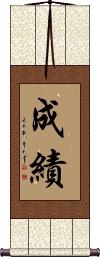
成績 is a Chinese, Japanese, and old Korean Hanja word that means achievement.
Depending on the context, it can also mean performance records, grades, or results.
Achievement / Accomplishment
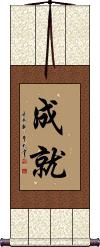
成就 is the word most often used in Chinese, Korean and Japanese to mean accomplishment or achievement.
成就 can also be used to mean success, attain a result, fulfillment, realization, or completion.
Success
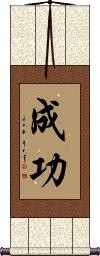
This Chinese and Japanese word for “success” is often used to refer to “career success” but is also used for other successes in life.
It matches the western dictionary definition of “The achievement of something desired, planned, or attempted.” And It's also used in this old Chinese proverb:  which means Failure is the Mother of Success.
Sometimes this word is translated as prosperity, but success, succeed, or successfully are more correct definitions.
See Also: Prosperity
Dream Come True / Enjoy Success
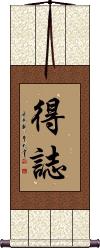
得誌 is a Chinese word that means to accomplish one's ambition, a dream come true, or to enjoy your success.
Failure is the Origin of Success
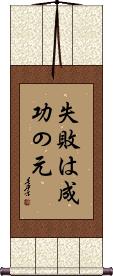
This Japanese proverb reads, “failure/mistake/blunder/defeat is the origin of success.”
It suggests that failures or defeats are a necessary part of success.
失敗は成功の元 is often translated as “Failure is a stepping stone to success.”
Note: There are a few similar variations of this idiom in Japanese.
Note: Because this selection contains some special Japanese Hiragana characters, it should be written by a Japanese calligrapher.
See Also: Failure is a Stepping Stone to Success
Failure is a Stepping Stone to Success
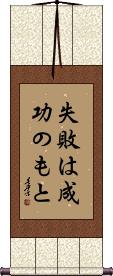
This Japanese proverb literally reads, “failures/mistakes/blunders are the yeast-starter/yeast-mash of success.”
it suggests that failures are a necessary part of success; Just as bread or beer requires yeast to successfully rise or brew/ferment.
Note: Because this selection contains some special Japanese Hiragana characters, it should be written by a Japanese calligrapher.
Any success cannot compensate for failure in the home
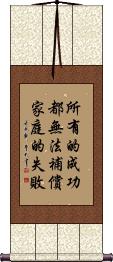
所有的成功都無法補償家庭的失敗 is a Chinese proverb that can be translated into English as “No success can compensate for failure in the home.”
Also, the word “home” can be exchanged with “family.”
Realize Your Ambitions / Ride on the Crest of Success
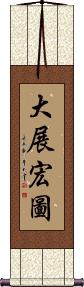
大展宏圖 is a four-character proverb used in Chinese to mean “realize your ambitions” or “exhibit your ambition and success.”
It's used to talk about someone with great career ambitions. Almost literally, it expresses the idea of someone unfolding a great career like a map or a set of blueprint plans.
Very literally translated, these four characters mean “Great unfolding of a huge map” or “Great exhibition of a colossal plan.”
Do not fear the task: Cooperation will lead to success
Do not fear strong winds waves; just be sure to row in unison
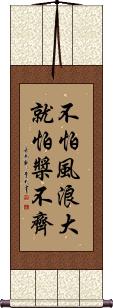
不怕风浪大就怕桨不齐 is a Chinese proverb that literally translates as: Do not fear strong winds [and] high waves; what [one should] worry about whether or not you're rowing in unison.
Figuratively, this means: However difficult the task, the key to success lies in making collective efforts.
I like to translate this as “Don't sweat the details, just get together and get it done.”
Failure is the Mother of Success
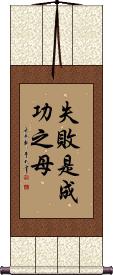
失败是成功之母 is a Chinese and Korean proverb that means “Every failure that you experience is a chance to learn from it and find success.”
Knowing what does not work is just as important as finding out what does work.
See Also: Experience is the Mother of Wisdom
Failure is the Mother of Success
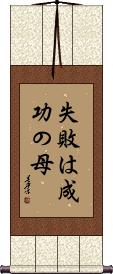
失敗は成功の母 is a Japanese proverb that means exactly what you think.
Every failure that you experience is a chance to learn from it and find success.
Knowing what does not work is just as important as finding out what does work.
Note: This is the Japanese version of an ancient Chinese proverb.
Note: Because this selection contains some special Japanese Hiragana characters, it should be written by a Japanese calligrapher.
See Also: Experience is the Mother of Wisdom
Esprit de Corps / Determination
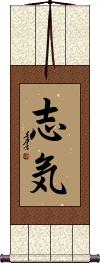
志気 is a Japanese word that can mean “esprit de corps” or “determination to achieve.”
When this is pronounced “Shige,” it can refer to a place in Japan. It can also be a Japanese surname, Shiki.
Determination to Achieve / Will-Power
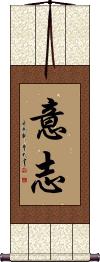
意志 is a Chinese, Korean, and Japanese word that means “determination to achieve.” It can also be translated as: will; willpower; determination; volition; intention; or intent.
In Japanese, this can also be the given name, Ishi.
Determination to Achieve
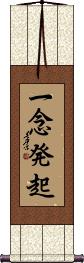
一念発起 is a Japanese proverb, “Ichinen Hokki,” which suggests being resolved to do something or having a wholehearted intention to accomplish something.
Some will translate this as “the determination to accomplish something,” or “turning over a new leaf and being determined to find success.”
Achieve Inner Peace; Find Deep Understanding
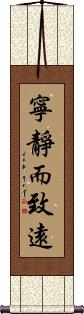
寧靜而致遠 is five characters from a longer ten-character proverb composed by Zhuge Liang about 1800 years ago.
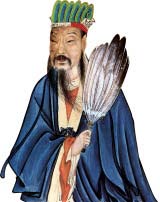
诸葛亮 Zhuge Liang
The proverb means “Your inner peace/tranquility/serenity will help you see or reach far (into the world).”
The last word means “far” but the deeper meaning is that you will surpass what you can currently see or understand. Perhaps even opening up vast knowledge and understanding of complex ideas.
We are not born with knowledge, how does one achieve maturity?
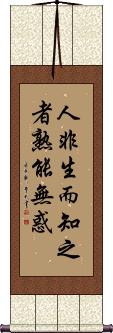
This figuratively means “Without a teacher, how can we learn/mature?”
人非生而知之者熟能無惑 is a philosophic pondering by Han Yu, a Tang Dynasty essayist, and philosopher (618-907 A.D.). This is a Chinese proverb that can mean “Knowledge is not innate to man, how can we overcome doubt?” or, “We are not born with knowledge, how does one achieve maturity?.”
This infers that we need the guidance of a teacher if we wish to learn, mature, and become better.
The following table may be helpful for those studying Chinese or Japanese...
| Title | Characters | Romaji (Romanized Japanese) | Various forms of Romanized Chinese | |
| Achievement | 成績 成绩 | seiseki | chéng jì / cheng2 ji4 / cheng ji / chengji | ch`eng chi / chengchi / cheng chi |
| Achievement Accomplishment | 成就 | jouju / joju | chéng jiù cheng2 jiu4 cheng jiu chengjiu | ch`eng chiu chengchiu cheng chiu |
| Success | 成功 | seikou / seiko | chéng gōng cheng2 gong1 cheng gong chenggong | ch`eng kung chengkung cheng kung |
| Dream Come True Enjoy Success | 得誌 得志 | dé zhì / de2 zhi4 / de zhi / dezhi | te chih / techih | |
| Failure is the Origin of Success | 失敗は成功の元 | shippai wa seikou no moto shippaiwaseikounomoto shipai wa seiko no moto | ||
| Failure is a Stepping Stone to Success | 失敗は成功のもと | sittpai wa seikou no moto sittpaiwaseikounomoto sittpai wa seiko no moto | ||
| Any success cannot compensate for failure in the home | 所有的成功都無法補償家庭的失敗 所有的成功都无法补偿家庭的失败 | suǒ yǒu de chéng gōng dōu wú fǎ bǔ cháng jiā tíng de shī bài suo3 you3 de cheng2 gong1 dou1 wu2 fa3 bu3 chang2 jia1 ting2 de shi1 bai4 suo you de cheng gong dou wu fa bu chang jia ting de shi bai | so yu te ch`eng kung tou wu fa pu ch`ang chia t`ing te shih pai so yu te cheng kung tou wu fa pu chang chia ting te shih pai |
|
| Realize Your Ambitions Ride on the Crest of Success | 大展宏圖 大展宏图 | dà jiǎn hóng tú da4 jian3 hong2 tu2 da jian hong tu dajianhongtu | ta chien hung t`u tachienhungtu ta chien hung tu |
|
| Do not fear the task: Cooperation will lead to success | 不怕風浪大就怕槳不齊 不怕风浪大就怕桨不齐 | bù pà fēng làng dà jiù pà jiǎng bù qí bu4 pa4 feng1 lang4 da4 jiu4 pa4 jiang3 bu4 qi2 bu pa feng lang da jiu pa jiang bu qi | pu p`a feng lang ta chiu p`a chiang pu ch`i pu pa feng lang ta chiu pa chiang pu chi |
|
| Failure is the Mother of Success | 失敗是成功之母 失败是成功之母 | shī bài shì chéng gōng zhī mǔ shi1 bai4 shi4 cheng2 gong1 zhi1 mu3 shi bai shi cheng gong zhi mu shibaishichenggongzhimu | shih pai shih ch`eng kung chih mu shih pai shih cheng kung chih mu |
|
| Failure is the Mother of Success | 失敗は成功の母 | shippai wa seikou no haha shippaiwaseikounohaha shipai wa seiko no haha | ||
| Esprit de Corps Determination | 志気 | shi ki / shi ge shiki / shige | ||
| Determination to Achieve Will-Power | 意志 | ishi | yì zhì / yi4 zhi4 / yi zhi / yizhi | i chih / ichih |
| Determination to Achieve | 一念発起 | ichi nen ho kki ichinenhokki ichi nen ho ki | ||
| Achieve Inner Peace; Find Deep Understanding | 寧靜而致遠 宁静而致远 | níng jìng ér zhì yuǎn ning2 jing4 er2 zhi4 yuan3 ning jing er zhi yuan ningjingerzhiyuan | ning ching erh chih yüan ningchingerhchihyüan |
|
| We are not born with knowledge, how does one achieve maturity? | 人非生而知之者熟能無惑 | rén fēi shēng ér zhī zhī zhě shú néng wú huò ren2 fei1 sheng1 er2 zhi1 zhi1 zhe3 shu2 neng2 wu2 huo4 ren fei sheng er zhi zhi zhe shu neng wu huo | jen fei sheng erh chih chih che shu neng wu huo | |
| In some entries above you will see that characters have different versions above and below a line. In these cases, the characters above the line are Traditional Chinese, while the ones below are Simplified Chinese. | ||||

Successful Chinese Character and Japanese Kanji calligraphy searches within the last few hours...



