Many custom options...


And formats...



Stock in Chinese / Japanese...
Buy a Stock calligraphy wall scroll here!
Personalize your custom “Stock” project by clicking the button next to your favorite “Stock” title below...
Stock
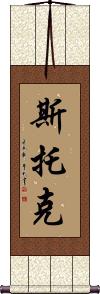
斯托克 is the name Stock in Chinese (Mandarin).
Stock

ストック is the name Stock in Japanese Katakana.
Note: Because this title is entirely Japanese Katakana, it should be written by a Japanese calligrapher.
Risk / Venture
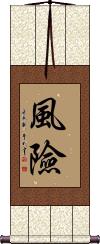
風險 is the Chinese word that means risk or venture.
風險 is mostly used in the context of a business venture or the risk you might take on the stock market.
If you like to gamble on the stock market or “let it all hang out” when doing business transactions, this might be the wall scroll for you.
Loving-Kindness Conquers All
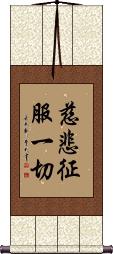
慈悲征服一切 is a way to express the idea that mercy, compassion, and loving-kindness can overcome all things.
This phrase is composed of 3 Chinese words:
慈悲 = loving-kindness; mercy; compassion; benevolence. It's used in Buddhism a lot to express the idea of how one should treat everyone else and all living beings.
征服 = to conquer; to subdue; to vanquish; to overcome.
一切 = all; everything; the whole; lock, stock, and barrel; without exception.
These search terms might be related to Stock:
Carry On, Undaunted
Chop Wood, Carry Water
Earth Goat/Sheep
Eight Black Horses
Fire Goat/Sheep
Goat / Sheep
Golden/Metal Goat/Sheep
Hoard
Keep Calm in Face of Adversity
Keep Calm, Be Not Impatient
Keep Your Feet on the Ground
Les Chevaux / Horses
Sell
Water Goat/Sheep
Wood Goat/Sheep
Not the results for Stock that you were looking for?
Below are some entries from our dictionary that may match your Stock search...
| Characters If shown, 2nd row is Simp. Chinese |
Pronunciation Romanization |
Simple Dictionary Definition |
山 see styles |
shān shan1 shan yamamura やまむら |
More info & calligraphy: Mountain(n,ctr) (1) mountain; hill; (n,ctr) (2) mine; (n,ctr) (3) (mountain) forest; (n,ctr) (4) heap; pile; stack; mountain; (5) protruding or high part of an object; crown (of a hat); thread (of a screw); tread (of a tire); (6) climax; peak; critical point; (7) guess; speculation; gamble; (8) (slang) (kana only) (police and crime reporter jargon; usu. written as ヤマ) (criminal) case; crime; (9) mountain climbing; mountaineering; (10) (See 山鉾) festival float (esp. one mounted with a decorative halberd); (11) {cards} (See 山札・1) deck (from which players draw cards); draw pile; stock; (12) {mahj} wall; wall tile; (prefix noun) (13) (before the name of a plant or animal) wild; (personal name) Yamamura A hill, mountain; a monastery. |
玉 see styles |
yù yu4 yü hikaru ひかる |
More info & calligraphy: Jade(1) (also formerly read as ごく) precious stone (esp. jade); (2) {food} (occ. ギョク) egg (esp. as a sushi topping); (3) stock or security being traded; product being bought or sold; (4) (See 建玉) position (in finance, the amount of a security either owned or owed by an investor or dealer); (5) geisha; (6) (abbreviation) (See 玉代) time charge for a geisha; (7) (abbreviation) {shogi} (See 玉将) king (of the junior player); (female given name) Hikaru Jade, a gem; jade-like, precious; you, your. |
ふおん see styles |
fon フォン |
{food} fond (fre:); (soup) stock; (personal name) Fons |
紫羅蘭 紫罗兰 see styles |
zǐ luó lán zi3 luo2 lan2 tzu lo lan |
More info & calligraphy: Violet |
ストック see styles |
sutokku ストック |
More info & calligraphy: Stock |
台 see styles |
tái tai2 t`ai tai dai だい |
(classical) you (in letters); variant of 臺|台[tai2] (n,n-suf) (1) stand; rest; base; pedestal; platform; table; holder; support; rack; (2) setting (of a gem); mounting; (3) (See 台木・1) stock (in grafting); (counter) (4) counter for machines and vehicles; (suffix) (5) (after a rounded value) level (e.g. price level); mark; range; decade (of one's life); (suffix noun) (6) tall building (with a fine view); (observation) platform; (suffix noun) (7) (in place names) plateau; heights; (surname) Dai A flat place, platform, plateau, terrace; an abbrev. for 臺 and for 天台 Tiantai, hence 台嶽 the Tiantai mountain; 台宗; 台家 its 'school'; 台徒 its disciples; 台教; 台道 its doctrine, or way. |
股 see styles |
gǔ gu3 ku ko もも |
thigh; part of a whole; portion of a sum; (finance) stock; share; strand of a thread; low-level administrative unit, translated as "section" or "department" etc, ranked below 科[ke1]; classifier for long winding things like ropes, rivers etc; classifier for smoke, smells etc: thread, puff, whiff; classifier for bands of people, gangs etc; classifier for sudden forceful actions (1) thigh; (can be adjective with の) (2) femoral; (1) crotch; crutch; groin; thigh; (2) fork (in a tree, road, river, etc.); tines (of a fork) thigh |
血 see styles |
xuè xue4 hsüeh chi ち |
blood; colloquial pr. [xie3]; CL:滴[di1],片[pian4] (1) blood; (2) blood; ancestry; lineage; stock; (3) (the) blood; feelings; passions Blood. 以血洗血 To wash out blood with blood, from one sin to fall into another. |
識 识 see styles |
zhì zhi4 chih tsuguhide つぐひで |
to record; to write a footnote (1) acquaintanceship; (2) {Buddh} vijnana; consciousness; (3) (after a signature) written by ...; (personal name) Tsuguhide vijñāna, "the art of distinguishing, or perceiving, or recognizing, discerning, understanding, comprehending, distinction, intelligence, knowledge, science, learning . . . wisdom." M.W. parijñāna, "perception, thorough knowledge," etc. M.W. It is intp. by 心 the mind, mental discernment, perception, in contrast with the object discerned; also by 了別 understanding and discrimination. There are classifications of 一識 that all things are the one mind, or are metaphysical; 二識 q. v. discriminating the ālaya-vijñāna or primal undivided condition from the mano-vijñāna or that of discrimination; 三識 in the Laṅkāvatāra Sutra, fundamental, manifested and discriminate; 五識 q.v. in the 起信論, i.e. 業, 轉, 現, 知, and 相續識; 六識 the perceptions and discernings of the six organs of sense; also of 8, 9, 10, and 11 識. The most important is the eight of the 起信論, i.e. the perceptions of the six organs of sense, eye, ear, nose, tongue, body (or touch), and mind, together with manas, intp. as 意識 the consciousness of the previous moment, on which the other six depend; the eighth is the ālaya-vijñāna, v. 阿賴耶, in which is contained the seed or stock of all phenomena and which 無沒 loses none, or nothing, is indestructible; a substitute for the seventh is ādāna 'receiving' of the 唯識, which is intp. as 無解 undiscriminated, or indefinite perception; there is a difference of view between the 相 and the 性 schools in regard to the seventh and eight 識; and the latter school add a ninth called the amala, or pure vijñāna, i.e. the non-phenomenal 眞如識. The esoterics add that all phenomena are mental and all things are the one mind, hence the one mind is 無量識 unlimited mind or knowledge, every kind of knowledge, or omniscience. vijñāna is one of the twelve nidānas.; Ālaya-vijñāna and mano-vijñāna; i. e. 阿梨耶 | and 分別事 |; v. 識. |
貯 贮 see styles |
zhù zhu4 chu osamu おさむ |
to store; to save; stockpile; Taiwan pr. [zhu3] (personal name) Osamu to stock up |
TS see styles |
tii esu; tiiesu(sk) / ti esu; tiesu(sk) ティー・エス; ティーエス(sk) |
(1) (See トランスセクシュアル) transsexual; (n,vs,vi) (2) (slang) gender swap (in fiction); genderswap; sex change; (3) (See トータルステーション) total station; (4) {finc} (See トラッキングストック) tracking stock |
三尊 see styles |
sān zūn san1 zun1 san tsun sanzon; sanson さんぞん; さんそん |
(1) (さんぞん only) {Buddh} Buddha triad; image of a Buddha attended by two Bodhisattvas; (2) (さんぞん only) {Buddh} (See 三宝) The Three Jewels; Buddha, the teachings of Buddha, and the community of monks and nuns; (3) (さんぞん only) (See 三尊天井) head and shoulders (stock price, etc. chart pattern); (4) the three people one must esteem: master, father, teacher The three honoured ones: Buddha, the Law, the Ecclesia or Order. Others are: Amitābha, Avalokiteśvara, and Mahāsthāmaprāpta, who, according to the Pure-land sect, come to welcome the dying invoker. Another group is Bhaiṣajya, Vairocana, and Candraprabha; and another, Śākyamunī, Mañjuśrī, and Samantabhadra. |
上場 上场 see styles |
shàng chǎng shang4 chang3 shang ch`ang shang chang kanba かんば |
on stage; to go on stage; to take the field (noun, transitive verb) (1) listing (on the stock exchange, etc.); taking (a company) public; (noun, transitive verb) (2) (See 上演) performance (of a play, opera, etc.); staging; presentation; (surname) Kanba |
上市 see styles |
shàng shì shang4 shi4 shang shih kamiichi / kamichi かみいち |
to hit the market (of a new product); to float (a company on the stock market) (adj-f,vs) going on the market; placing on the market; (place-name, surname) Kamiichi |
上湯 see styles |
shantan シャンタン |
(kana only) top-grade Chinese soup stock (chi: shàngtāng) |
上證 上证 see styles |
shàng zhèng shang4 zheng4 shang cheng |
Shanghai Stock Exchange (SSE), abbr. for 上海證券交易所|上海证券交易所[Shang4 hai3 Zheng4 quan4 Jiao1 yi4 suo3] |
主板 see styles |
zhǔ bǎn zhu3 ban3 chu pan |
(computing) motherboard; (stock market) main board |
乗換 see styles |
norikae のりかえ |
(noun/participle) (1) transfer (trains, buses, etc.); connection; connexion; (2) (econ) switching (stock); (3) (biol) chromosomal crossover; crossing over |
休場 see styles |
yasunba やすんば |
(n,vs,vi) (1) (temporary) closure (of a theater, entertainment venue, etc.); (n,vs,vt,vi) (2) absence (from a performance, match, etc.); sitting out; (n,vs,vt,vi) (3) {sumo} absence (from a bout or tournament); (n,vs,vi) (4) {stockm} holiday; closure (of a stock exchange); (place-name) Yasunba |
低迷 see styles |
dī mí di1 mi2 ti mi teimei / teme ていめい |
blurred (landscape etc); low (spirits); in a slump (economy) (n,vs,vi) (1) hanging low (of clouds); (n,vs,vi) (2) remaining low (of sales, stock prices, etc.); remaining sluggish (of the economy, market, etc.); hovering (around a low level); floundering; slump; depression |
借株 see styles |
karikabu かりかぶ |
{sumo} rented coaching stock |
停盤 停盘 see styles |
tíng pán ting2 pan2 t`ing p`an ting pan |
to suspend trading (stock market) |
兜町 see styles |
kabutochou / kabutocho かぶとちょう |
(1) Kabutochō (neighbourhood of Nihonbashi, Tokyo, where the Tokyo Stock Exchange is located); (2) (colloquialism) (See 東京証券取引所) Tokyo Stock Exchange; (place-name) Kabutocho (location of the Tokyo Stock Exchange) |
共台 see styles |
tomodai ともだい |
free stock (in grafting); compatible rootstock |
凝然 see styles |
níng rán ning2 ran2 ning jan gyounen / gyonen ぎょうねん |
(adv-to,adj-t) stock-still; motionless; frozen in place; (person) Gyōnen (1240-1321) (Buddhist monk) firmly |
出し see styles |
dashi だし |
(1) (kana only) dashi (Japanese soup stock made from fish and kelp); (2) pretext; excuse; pretense (pretence); dupe; front man; (place-name) Dashi |
出汁 see styles |
chū zhī chu1 zhi1 ch`u chih chu chih dashi だし |
dashi (soup stock used in Japanese cuisine) (orthographic borrowing from Japanese) (kana only) dashi (Japanese soup stock made from fish and kelp) |
出自 see styles |
chū zì chu1 zi4 ch`u tzu chu tzu shutsuji しゅつじ |
to come from (1) origin; birthplace; (2) descent; lineage; ancestry; stock |
初値 see styles |
hatsune はつね |
(1) first quotation for a stock at the first exchange meeting of the New Year; (2) initial share price during a public offering |
割下 see styles |
warishita わりした |
(food term) (abbreviation) sukiyaki stock; stock mixed with soy sauce, mirin and sugar (used to flavor sukiyaki); (surname) Warishita |
Click here for more Stock results from our dictionary
The following table may be helpful for those studying Chinese or Japanese...
| Title | Characters | Romaji (Romanized Japanese) | Various forms of Romanized Chinese | |
| Stock | 斯托克 | sī tuō kè si1 tuo1 ke4 si tuo ke situoke | ssu t`o k`o ssutoko ssu to ko |
|
| Stock | ストック | sutokku / sutoku | ||
| Risk Venture | 風險 风险 | fēng xiǎn feng1 xian3 feng xian fengxian | feng hsien fenghsien |
|
| Loving-Kindness Conquers All | 慈悲征服一切 | cí bēi zhēng fú yī qiè ci2 bei1 zheng1 fu2 yi1 qie4 ci bei zheng fu yi qie cibeizhengfuyiqie | tz`u pei cheng fu i ch`ieh tzupeichengfuichieh tzu pei cheng fu i chieh |
|
| In some entries above you will see that characters have different versions above and below a line. In these cases, the characters above the line are Traditional Chinese, while the ones below are Simplified Chinese. | ||||

Successful Chinese Character and Japanese Kanji calligraphy searches within the last few hours...



