Many custom options...


And formats...



Not what you want?
Try other similar-meaning words, fewer words, or just one word.
Physical Strength in Chinese / Japanese...
Buy a Physical Strength calligraphy wall scroll here!
Personalize your custom “Physical Strength” project by clicking the button next to your favorite “Physical Strength” title below...
9. Great Power
Physical Strength
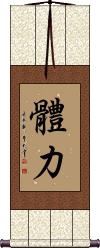
Physical Strength
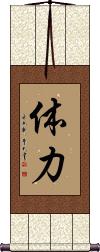
体力 means “physical strength” or “physical power.”
The first character was first simplified in Japan. Later, that simplified version became the standard in mainland China. Just in case you want this version, it is offered here. I suggest it if your audience is Japanese. Most Chinese know the older traditional version, which looks like 體力.
体力 can also be defined: stamina; endurance; physical strength; resilience; resistance to disease; clout; stability.
Inner Strength
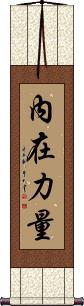
內在力量 is the slightly-verbose way to say inner strength.
The first two characters mean “intrinsic” or “inner.” The second two characters mean “power,” “force” or “strength” (especially physical strength). 內在力量 is more a short phrase rather than just a word in Chinese and Korean. This can sort of be understood in Japanese but it's not normal/proper Japanese.
Power / Strength
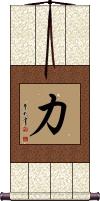
力 is the simplest form of “power” or “strength.”
In Japanese, it is pronounced “chikara” when used alone, and “ryoku” when used in a sentence (there are also a few other possible pronunciations of this Kanji in Japanese).
In some contexts, this can mean ability, force, physical strength, capability, and influence.
Strength / Ability
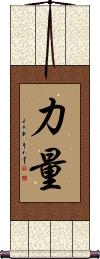
力量 is a general strength term.
It can refer to mental or physical strength (depending on context). 力量 can also be used to describe strength in terms of capability, capacity, ability, and even tact. Some may translate this as power or force.
Strength and Honor
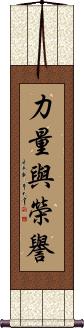
力量與榮譽 is “strength and honor” in Chinese.
The first two characters are usually understood as (physical) strength but can also mean power or force.
The middle character is a connecting particle similar to “and.”
The last two characters are a way to say honor but can also be understood as honorable reputation, honorary, or glory.
Strength / Vigor / Energy
Physical Strength
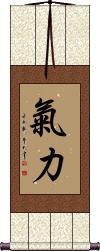
氣力 can mean any of the words in the title above, and in some contexts, can also mean effort, will-power, or talent.
This refers mostly to physical strength (as opposed to mental or spiritual).
 In modern Japan, they use a simplified first character for this word. If you want to order this title with that special Japanese version, click on the character to the right instead of the button above.
Strong / Powerful / Force
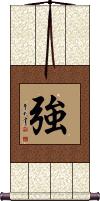
強 is a character that means strong, strength, force, powerful, better, stubborn, and stiff (yes, all of this in one character).
This “strong” has less to do with physical strength and more to do with having a winning attitude, or just having the ability to win at something.
Note that most of the time, this character is pronounced “qiang” but when used with the meaning of stubborn, unyielding, or stiff, it is pronounced “jiang” in Chinese.
Also, sometimes “qiang” is used in modern Chinese to describe people that do crazy things (For example: Bicycling from Beijing to Tibet alone). I sometimes can be found outside my Beijing apartment wearing nothing but shorts and a tee-shirt while eating ice cream during a snow storm, just to hear my neighbors call me “qiang.” Maybe they mean “strong” but perhaps they are using the new meaning of “crazy strong.”
強 can also be a Chinese surname that romanizes as Jiang in the mainland or Chiang if from Taiwan.
強 is a valid Korean Hanja character with the same meaning but is mostly used in compound Korean words.
強 is used in Japanese (though normally in compound words). In Japanese, it has the same meaning but in some contexts can mean “a little more than...” or “a little over [some amount].” Most Japanese would read this as tough, strength, stiff, hard, inflexible, obstinate, or stubborn.
The variant 彊 is sometimes seen in older literature.
Body and Earth in Unity
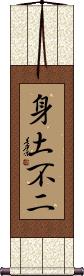
身土不二 (Shindofuni) is originally a Buddhist concept or proverb referring to the inseparability of body-mind and geographical circumstances.
This reads, “Body [and] earth [are] not two.”
Other translations or matching ideas include:
Body and land are one.
Body and earth can not be separated.
Body earth sensory curation.
You are what you eat.
Indivisibility of the body and the land (because the body is made from food and food is made from the land).
Going further, this speaks of our human bodies and the land from which we get our food being closely connected. This phrase is often used when talking about natural and organic vegetables coming directly from the farm to provide the healthiest foods in Japan.
Character notes: 身(shin) in this context does not just mean your physical body but a concept including both body and mind.
土 (do) refers to the soil, earth, clay, land, or in some cases, locality. It's not the proper name of Earth, the planet. However, it can refer to the land or realm we live in.
Japanese note: This has been used in Japan, on and off, since 1907 as a slogan for a governmental healthy eating campaign (usually pronounced as shindofuji instead of the original shindofuni in this context). It may have been hijacked from Buddhism for this propaganda purpose, but at least this is “healthy propaganda.”
Korean note: The phrase 身土不二 was in use by 1610 A.D. in Korea, where it can be found in an early medical journal.
In modern South Korea, it's written in Hangul as 신토불이. Korea used Chinese characters (same source as Japanese Kanji) as their only written standard form of the language until about a hundred years ago. Therefore, many Koreans will recognize this as a native phrase and concept.
See Also: Strength and Love in Unity
Great Power
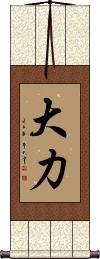
大力 can mean immense physical strength or great power.
This can also act as an adjective for expressing how energetically or vigorously something is.
This can also be a given name, Dairiki, in Japanese.
This in-stock artwork might be what you are looking for, and ships right away...
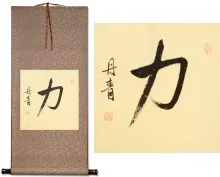
Gallery Price: $65.00
Your Price: $39.77

Gallery Price: $60.00
Your Price: $36.88
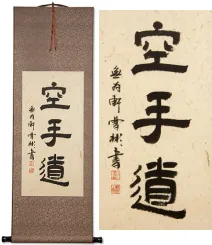

Gallery Price: $31.00
Your Price: $16.88

Gallery Price: $222.00
Your Price: $122.88

Gallery Price: $200.00
Your Price: $122.88
Gallery Price: $108.00
Your Price: $59.88
Gallery Price: $106.00
Your Price: $58.88
Gallery Price: $90.00
Your Price: $49.88
Gallery Price: $72.00
Your Price: $39.88

Gallery Price: $40.00
Your Price: $16.88

Gallery Price: $240.00
Your Price: $148.88

Gallery Price: $240.00
Your Price: $148.88
The following table may be helpful for those studying Chinese or Japanese...
| Title | Characters | Romaji (Romanized Japanese) | Various forms of Romanized Chinese | |
| Physical Strength | 體力 体力 | tai ryoku / tairyoku | tǐ lì / ti3 li4 / ti li / tili | t`i li / tili / ti li |
| Physical Strength | 體力 体力 | tairyoku | tǐ lì / ti3 li4 / ti li / tili | t`i li / tili / ti li |
| Inner Strength | 內在力量 内在力量 | nèi zài lì liàng nei4 zai4 li4 liang4 nei zai li liang neizaililiang | nei tsai li liang neitsaililiang |
|
| Power Strength | 力 | chikara / ryoku | lì / li4 / li | |
| Strength Ability | 力量 | riki ryou / rikiryou / riki ryo | lì liàng / li4 liang4 / li liang / liliang | |
| Strength and Honor | 力量與榮譽 力量与荣誉 | lì liàng yǔ róng yù li4 liang4 yu3 rong2 yu4 li liang yu rong yu liliangyurongyu | li liang yü jung yü liliangyüjungyü |
|
| Strength Vigor Energy | 氣力 气力 / 気力 | kiryoku | qì lì / qi4 li4 / qi li / qili | ch`i li / chili / chi li |
| Strong Powerful Force | 強 强 | kyou / kyo | qiáng / qiang2 / qiang | ch`iang / chiang |
| Body and Earth in Unity | 身土不二 | shindofuni / shindofuji | ||
| Great Power | 大力 | dai riki / dairiki | dà lì / da4 li4 / da li / dali | ta li / tali |
| In some entries above you will see that characters have different versions above and below a line. In these cases, the characters above the line are Traditional Chinese, while the ones below are Simplified Chinese. | ||||

Successful Chinese Character and Japanese Kanji calligraphy searches within the last few hours...



