Many custom options...


And formats...



Peace and Tranquility in Chinese / Japanese...
Buy a Peace and Tranquility calligraphy wall scroll here!
Personalize your custom “Peace and Tranquility” project by clicking the button next to your favorite “Peace and Tranquility” title below...
2. Tranquil / Tranquility / Serenity
9. Worldwide Wish for Peace and Prosperity
10. Inner Bliss and Peace from Meditation
11. Reach Peace and Calm Through Meditation
12. Peacefulness / Tranquility / Perfectly Quiet
13. Spiritual Peace / Enlightened Peace
14. Tranquility Yields Transcendence
15. Inner Peace
17. Peace / Harmony
18. Great Peace
19. Inner Peace / Silence / Serenity
20. Worldwide Peace
22. Live in Peace and Contentment
23. World Peace
24. House Of Peace
25. World Peace
26. Eternal Peace
28. Patience Brings Peace of Mind
29. Faith Love Peace
30. Eternal Peace and Happiness
33. Patience Yields Peace of Mind
34. Achieve Inner Peace; Find Deep Understanding
35. Balance / Peace
36. Peaceful Heart / Peace of Mind / Calm Mind
37. A Life of Serenity Yields Understanding
38. Good Health / Healthy / Vigor
39. Safe and Sound
Peace and Tranquility
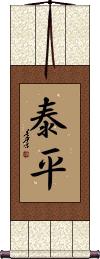
泰平 means peace and/or tranquility in Japanese and Korean (also understood but not as common in Chinese).
Peace and Tranquility
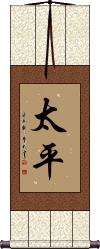
太平 means “peace and tranquility” or “peace and security” in Chinese, Japanese Kanji, and old Korean Hanja.
The literal translation would be “very balanced” or “very peaceful.”
The first character means very, much, too much, or extremely.
The second character means balanced, peaceful, calm, equal, even, level, or smooth.
Tranquil / Tranquility / Serenity
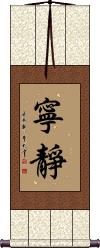
寧靜 expresses the idea of tranquility and serenity in Chinese.
See Also: Worldwide Peace | Inner Peace | Peace / Harmony | Stillness / Quiet / Calm
Serenity / Tranquility
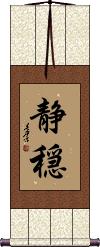
靜穏 is a Japanese-specific way to express “serenity” or “tranquility.”
Notes: The second Kanji is not a Chinese character - it was morphed or developed in Japan after Chinese characters were absorbed into the Japanese language during the 5th century.
The first character is slightly-simplified from the original Chinese form but still recognizable.
See Also: Worldwide Peace
Serenity / Tranquility
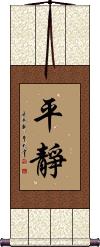
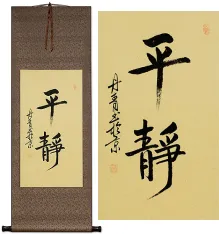
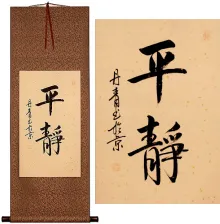
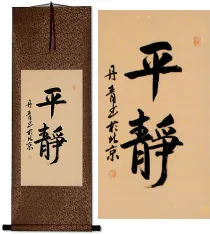
平靜 is one of several ways to express “serenity” or “tranquility” in Chinese, Japanese Kanji, and old Korean Hanja.
It can also be translated as calm, serenity, tranquil, undisturbed, or serene.
See Also: Worldwide Peace
Calm / Tranquility
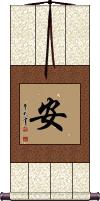
安 is used in many compound words in the CJK world.
Alone, this character has a broad span of possible meanings. These meanings include relaxed, quiet, rested, contented, calm, still, to pacify, peaceful, at peace, soothing, or soothed.
安 and even the pronunciation was borrowed from Chinese and absorbed into both Japanese Kanji and Korean Hanja. In all these languages, this character is pronounced like “an.”
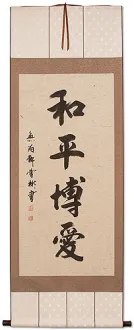
Peace and Love
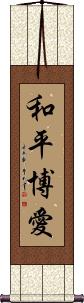
和平博愛 is the Chinese and Japanese way to express “Peace and Love.”
These are two separate words, so the calligrapher will put a slight space between the first two characters, which mean peace, and the last two, which represent universal love. This space is not shown on the sample character images for this phrase.
A special note: Word lists may seem okay in English but feel strange in Chinese and Japanese. We don't offer too many of them but this one is often-requested and feels okay in Chinese and Japanese, though a bit uncommon in Korean.
See Also: Worldwide Peace | Love
Peace of Mind
(five-character version)
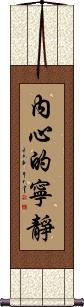
內心的寧靜 is the long way to express the idea of “peace of mind” in Chinese.
The first two characters mean heart or “innermost being.”
The middle character is a connecting modifier.
The last two characters mean peace, tranquility, or serenity.
Some may also translate this as “inner peace,” but I like our other inner-peace options for that idea.
This kind of makes sense in Korean but will have an archaic read - even by those who can understand Korean Hanja.
Peace / Peaceful
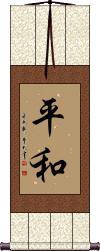
平和 is the Japanese and Korean order of these characters used most often to express the idea of peace, tranquility, and harmony.
It's just the reverse order of the Chinese. In this order in Chinese, it means takes the “mild” definition rather than “peace.” In Korean, the combination keeps the same meaning in either order.
The second character also means balance, so there is an element of harmony and balance along with peace.
Peace of Mind
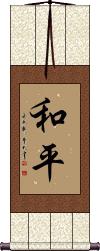
和平 is the Chinese order for these two characters, which means peace but can also be translated as amicability, specifically, or mildness. 和平 is often translated as a simple way to say “peace of mind.” This combination is used in Korean Hanja to mean “peace and harmony.”
Alone, the first character means peace and harmony.
The second character means balance when read by itself.
Note: 和平 are often seen in the opposite order in Japanese with the same meaning (You'll sometimes find them in this order in Japan, so either way is OK).
Worldwide Wish for Peace and Prosperity
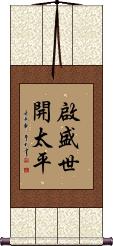
啟盛世開太平 means “To bring flourishing peace and security to the world (our current era).”
It's a wish that a new door leading to peace and prosperity could be opened to mankind.
Character and word breakdown:
啟 to open; to start; to initiate; to enlighten or awaken.
盛世 a flourishing period; period of prosperity; a golden age.
開 to open; to start; to turn on.
太平 peace and security; peace and tranquility; peace; tranquility.
I don't like to do breakdowns like this, as the words altogether create their unique meaning (encompassed in the main title above).
Inner Bliss and Peace from Meditation
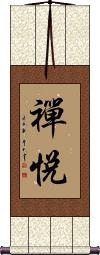
禪悅 is a title that refers to the inner bliss and peace you can achieve from meditation.
This term transcends a few religions, including Taoism and Buddhism. It can also be translated as “joy of the mystic trance” or simply “meditative bliss.”
Amazing that such a complex idea can be expressed in just two Chinese characters. Note that the first character is Chan/Zen (Chinese/Japanese), which means “meditation” in both languages.
Reach Peace and Calm Through Meditation
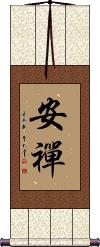
安禪 creates a title that means to reach peace and calm through meditation.
安禪 is an excellent wall scroll for your relaxation or meditation room.
This is also a Buddhist-related term that encompasses the idea of entering into dhyana meditation.
This is also used in Japanese, but in modern times, the second character has changed, so it's 安禅 now. If you want the modern Japanese version, just choose a Japanese calligrapher, and let me know when you place your order.
Peacefulness / Tranquility / Perfectly Quiet
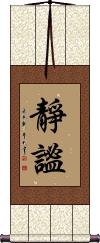
靜 and 謐 both mean quiet. Together, 靜謐 reinforces the meanings, almost creating a word that means “double quiet” or “perfect quiet.”
A good wall scroll for a library, reading room, or another quiet place.
See Also: Worldwide Peace | Peace / Harmony
Spiritual Peace / Enlightened Peace
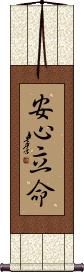
These Japanese Kanji, 安心立命, can mean “religious enlightenment” or “spiritual peace gained through faith.”
Other dictionaries define as “spiritual peace and enlightenment” or “keeping an unperturbed mind through faith.”
My Buddhist dictionary defines it as “spiritual peace and realization of enlightenment.”
In the Zen school, this is about settling one's body and life; attaining complete peace, and establishing one's course of life in accord with the ultimate reality.
Tranquility Yields Transcendence
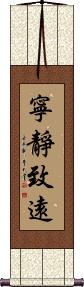
寧靜致遠 is an ancient Chinese idiom that means “tranquility yields transcendence.”
This suggests pursuing a quiet life of profound study.
The first two characters mean tranquility. The last two characters mean “go far,” which suggests achieving much in your life or expanding beyond normal limits. The direct translation would read something like, “[With] tranquility [in your life, you'll] go far.”
Compare this to the English idiom: Still waters run deep.
Inner Peace
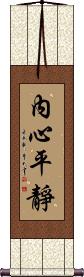
內心平靜 is a Chinese and Japanese phrase that is a direct translation of the western idea of inner peace.
The first two characters contain the idea of “heart,” “innermost being,” or “deep in the/your inner mind.”
The last two characters mean “tranquil” and “serene.”
I have seen this phrase used as “inner peace” for art prints and even on the side of coffee cups. But I think the translation is too literal. It feels like a direct translation from English rather than a nicely composed Chinese or Japanese phrase. See my other entries for “inner peace.”
See Also: Tranquil / Tranquility / Serenity | Simplicity | Worldwide Peace
Warrior for Peace
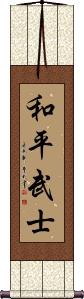
和平武士 means “Warrior for Peace” (a warrior who fights for peace) in Chinese.
Note this is not the same thing as a “peaceful warrior.”
See Also: Worldwide Peace
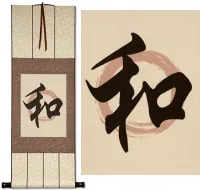
Peace / Harmony
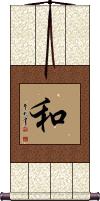
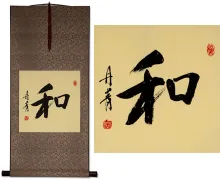
和 is the simplest form of peace and harmony.
和 can also be translated as the peaceful ideas of gentle, mild, kind, and calm. With a more harmonious context, it can mean union, together with, on good terms with, or on friendly terms.
Most people would just translate this character as peace and/or harmony. 和 is a very popular character in Asian cultures - you can even call it the “peace symbol” of Asia. In fact, this peace and harmony character was seen repeatedly during the opening ceremony of the 2008 Olympic Games in Beijing (a major theme of the games).
In old Chinese poems and literature, you might see this used as a kind of “and.” As in two things summed together. As much as you could say, “the sun and moon,” you could say “the sun in harmony with the moon.”
See Also: Inner Peace | Patience and Preparation | Simplicity
Great Peace
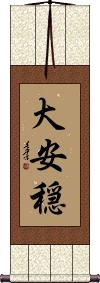
大安穏 means great peace, great repose, nirvanic peace, or great tranquility.
Inner Peace / Silence / Serenity
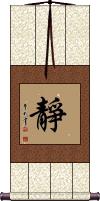
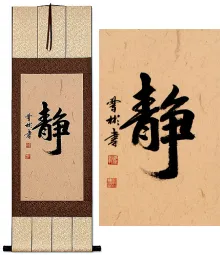
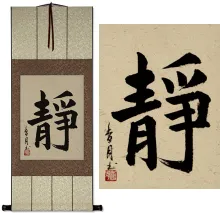
靜 is the simplest way to convey the meaning of inner peace and serenity.
靜 is often translated as “serenity.” It can also be used to express the ideas of still, calm, serene, quiet, silent, stillness, not moving, or tranquility.
In the old days, Chinese, Japanese, or Korean people might hang a wall scroll with this character in their reading room to bring about a sense of peace in the room.
 While they once used the same character form in Japan, they now use a slightly-simplified version in modern Japan (after WWII). This version is shown to the right, and can be selected for your wall scroll by clicking on that Kanji instead of the button above.
See Also: Worldwide Peace
Worldwide Peace
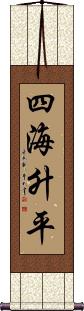
四海升平 literally means “all four oceans at peace,” which is a way to express “world peace.”
The Whole World at Peace
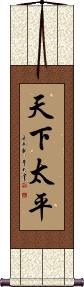
This proverb can mean the whole world at peace, peace and prosperity, peaceful and tranquil, peace reigns over the land, times of peace, peace and tranquillity, peaceful world, or from the Greek, times of halcyon.
Sometimes (rarely) written as 天下泰平 (variant 3rd character).
Live in Peace and Contentment
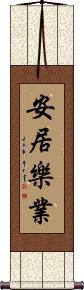
安居樂業 is the Chinese, Japanese Kanji, and old Korean Hanja proverb for “living in peace and working happily,” or “to live in peace and be content with one's occupation.”
World Peace
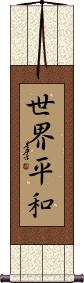
世界平和 is the Japanese title for “world peace” or “peace of the world.”
House Of Peace

和平之家 is the title “House Of Peace” in Chinese.
World Peace
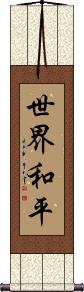
世界和平 is the Chinese title for “world peace.”
Eternal Peace
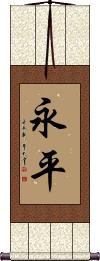
永平 is a way to write “eternal peace” in Chinese and Japanese.
This may also refer to Yongping county in Dali Bai autonomous prefecture. 永平 is also a Japanese surname that romanizes as Nagahira.
Stable - Mind at Peace
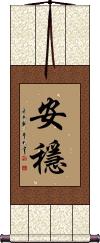
安穩 can mean a steady, stable, sedate, and calm mind.
Other translations include “body and mind at rest,” or “peace and comfort.”
Patience Brings Peace of Mind
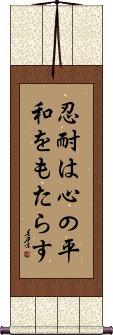
忍耐は心の平和をもたらす means “patience brings peace of mind,” in Japanese.
Note: Because this selection contains some special Japanese Hiragana characters, it should be written by a Japanese calligrapher.
Faith Love Peace
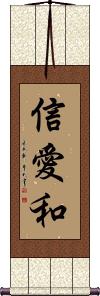
信愛和 is a word list that reads, “Faith Love Peace.”
This is not a natural phrase in Chinese or Japanese, as it lacks a subject, verb, or object. But if this is what you want, here it is.
Eternal Peace and Happiness

永恆和平與幸福 means “Eternal Peace And Happiness” in Chinese.
Peace and Good Health
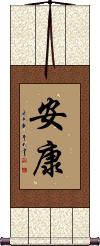
安康 means just what it says. It's a word that expresses both the idea of being at peace and healthy at the same time.
Note: 安康 is a bonafide word in Chinese and Korean, and the characters will at least make sense in Japanese.
Peace, Love, Happiness
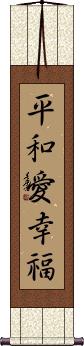
平和, 愛, 幸福 means “peace, love, happiness” in Japanese.
This is a word list, which is not the most natural kind of composition in Japanese (usually there is a subject, object, and verb - or a single word).
Peace, Love, Happiness
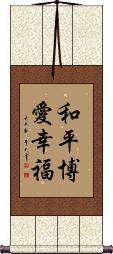
和平博愛幸福 is a word-list that means “peace, love, happiness,” in Chinese.
Word lists like this are not commonly-seen in China. Phrases with subject, verb, and object, or just single words are more natural for calligraphy artwork.
Patience Yields Peace of Mind
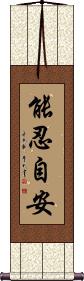
This ancient Chinese proverb can mean “Patience brings peace of mind,” “One who has patience finds peace,” and a few other ways.
Achieve Inner Peace; Find Deep Understanding
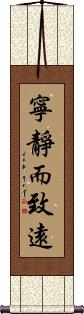
寧靜而致遠 is five characters from a longer ten-character proverb composed by Zhuge Liang about 1800 years ago.
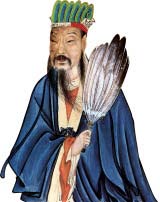
诸葛亮 Zhuge Liang
The proverb means “Your inner peace/tranquility/serenity will help you see or reach far (into the world).”
The last word means “far” but the deeper meaning is that you will surpass what you can currently see or understand. Perhaps even opening up vast knowledge and understanding of complex ideas.
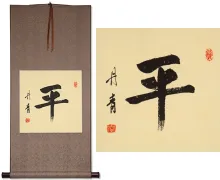
Balance / Peace
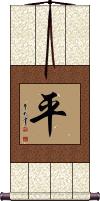
平 is a single character that means balance in Chinese but it's not too direct or too specific about what kind of balance.
Chinese people often like calligraphy art that is a little vague or mysterious. In this way, you can decide what it means to you, and you'll be right.
平 is also part of a word that means peace in Chinese, Japanese, and old Korean.
Some alternate translations of this single character include: balanced, peaceful, calm, equal, even, level, smooth, or flat.
Note that in Japanese, this just means “level” or “flat” by itself (not the best choice for balance if your audience is Japanese).
Peaceful Heart / Peace of Mind / Calm Mind
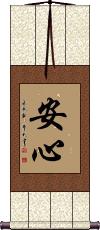
安心 can mean relief, peace of mind, feeling at ease, to be relieved, to set one's mind at rest, and easiness.
安心 is a nice word that encompasses great meanings within just two characters. Some of the other meanings include pacifying, settling the mind, and peace of mind. It's also the idea of feeling a sense of security, safety, and confidence in your state of well-being.
This can be used by everyone, but some consider it to be a Buddhist concept (You'll find it in your Zen dictionary).
Note: Can be romanized as Anshin or Anjin in Japanese.
A Life of Serenity Yields Understanding
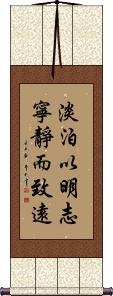
淡泊以明志寧靜而致遠 is a kind of complex ten-character proverb composed by Zhuge Liang about 1800 years ago.
淡泊以明志寧靜而致遠 is a Chinese proverb that means “Leading a simple life will yield a clear mind, and having inner peace will help you see far (into the world).”
What I have translated as “simple life” means NOT being materialistic and NOT competing in the rat race.
The last word means “far” but the deeper meaning is that you will surpass what you can currently see or understand. Perhaps even the idea of opening up vast knowledge and understanding of complex ideas.
The whole phrase has a theme that suggests that if you are NOT an aggressive, cut-throat person who fights their way to the top, no matter how many people they crush along the way, and instead seek inner peace, you will have a happier existence and be more likely to understand the meaning of life.
See Also: Tranquil / Tranquility / Serenity
Good Health / Healthy / Vigor
Also suggests being at peace
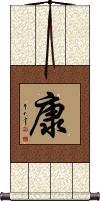
康 is a single character that means good health or vigor in Chinese, Japanese Kanji, and old Korean Hanja.
康 can also mean peaceful, at ease, or abundant in some contexts.
Please note that this is rarely seen alone in Japanese Kanji. In Japanese, it is used both for health-related compound words and to denote the kouhou through koushou eras of Japan.
In Korean, this can also be the family name “Kang” (caution: not the only family name romanized as Kang in Korean).
See Also: Strong / Healthy | Vitality | Wellness
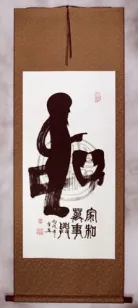
Safe and Sound
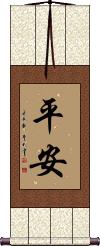
This means “safe and sound” in Chinese, Japanese, and Korean.
Can also be translated as well-being, peace, tranquility, quietness, and calmness.
Note: There is also a longer four-character version in our calligraphy database.
See Also: Tranquil / Tranquility / Serenity | Worldwide Peace
Safe and Sound
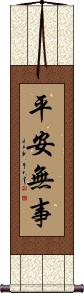
This proverb means “safe and sound without toil or trouble.”
It roughly means that all is well with a feeling of complete safety. The ideas contained in these characters include well-being, peace, tranquility, quietness, calmness, and non-problematic.
See Also: Tranquil / Tranquility / Serenity | Worldwide Peace
This in-stock artwork might be what you are looking for, and ships right away...


The following table may be helpful for those studying Chinese or Japanese...
| Title | Characters | Romaji (Romanized Japanese) | Various forms of Romanized Chinese | |
| Peace and Tranquility | 泰平 | taihei | ||
| Peace and Tranquility | 太平 | tai hei / taihei | tài píng / tai4 ping2 / tai ping / taiping | t`ai p`ing / taiping / tai ping |
| Tranquil Tranquility Serenity | 寧靜 宁静 | níng jìng ning2 jing4 ning jing ningjing | ning ching ningching |
|
| Serenity Tranquility | 靜穏 静穏 | seion | ||
| Serenity Tranquility | 平靜 平静 | heisei | píng jìng ping2 jing4 ping jing pingjing | p`ing ching pingching ping ching |
| Calm Tranquility | 安 | an | ān / an1 / an | |
| Peace and Love | 和平博愛 和平博爱 | wahei hakuai waheihakuai | hé píng bó ài he2 ping2 bo2 ai4 he ping bo ai hepingboai | ho p`ing po ai hopingpoai ho ping po ai |
| Peace of Mind | 內心的寧靜 内心的宁静 | nèi xīn de níng jìng nei4 xin1 de ning2 jing4 nei xin de ning jing neixindeningjing | nei hsin te ning ching neihsinteningching |
|
| Peace Peaceful | 平和 | hei wa / heiwa | píng hé / ping2 he2 / ping he / pinghe | p`ing ho / pingho / ping ho |
| Peace of Mind | 和平 | wa hei / wahei | hé píng / he2 ping2 / he ping / heping | ho p`ing / hoping / ho ping |
| Worldwide Wish for Peace and Prosperity | 啟盛世開太平 启盛世开太平 | qǐ shèng shì kāi tài píng qi3 sheng4 shi4 kai1 tai4 ping2 qi sheng shi kai tai ping qishengshikaitaiping | ch`i sheng shih k`ai t`ai p`ing chishengshihkaitaiping chi sheng shih kai tai ping |
|
| Inner Bliss and Peace from Meditation | 禪悅 禅悦 | chán yuè / chan2 yue4 / chan yue / chanyue | ch`an yüeh / chanyüeh / chan yüeh | |
| Reach Peace and Calm Through Meditation | 安禪 安禅 | an zen / anzen | ān chán / an1 chan2 / an chan / anchan | an ch`an / anchan / an chan |
| Peacefulness Tranquility Perfectly Quiet | 靜謐 静谧 | seihitsu | jìng mì / jing4 mi4 / jing mi / jingmi | ching mi / chingmi |
| Spiritual Peace Enlightened Peace | 安心立命 | an jin ritsu myou anjinritsumyou an jin ritsu myo | ||
| Tranquility Yields Transcendence | 寧靜致遠 宁静致远 | níng jìng zhì yuǎn ning2 jing4 zhi4 yuan3 ning jing zhi yuan ningjingzhiyuan | ning ching chih yüan ningchingchihyüan |
|
| Inner Peace | 內心平靜 内心平静 | naishin heizyou naishinheizyou naishin heizyo | nèi xīn píng jìng nei4 xin1 ping2 jing4 nei xin ping jing neixinpingjing | nei hsin p`ing ching neihsinpingching nei hsin ping ching |
| Warrior for Peace | 和平武士 | hé píng wǔ shì he2 ping2 wu3 shi4 he ping wu shi hepingwushi | ho p`ing wu shih hopingwushih ho ping wu shih |
|
| Peace Harmony | 和 | wa | hé / he2 / he | ho |
| Great Peace | 大安穏 | daiannon | ||
| Inner Peace Silence Serenity | 靜 静 | shizu / sei | jìng / jing4 / jing | ching |
| Worldwide Peace | 四海升平 | sì hǎi shēng píng si4 hai3 sheng1 ping2 si hai sheng ping sihaishengping | ssu hai sheng p`ing ssuhaishengping ssu hai sheng ping |
|
| The Whole World at Peace | 天下太平 | tenkataihei | tiān xià tài píng tian1 xia4 tai4 ping2 tian xia tai ping tianxiataiping | t`ien hsia t`ai p`ing tienhsiataiping tien hsia tai ping |
| Live in Peace and Contentment | 安居樂業 安居乐业 | an kyo raku gyou ankyorakugyou an kyo raku gyo | ān jū lè yè an1 ju1 le4 ye4 an ju le ye anjuleye | an chü le yeh anchüleyeh |
| World Peace | 世界平和 | sekaiheiwa | ||
| House Of Peace | 和平之家 | hé píng zhī jiā he2 ping2 zhi1 jia1 he ping zhi jia hepingzhijia | ho p`ing chih chia hopingchihchia ho ping chih chia |
|
| World Peace | 世界和平 | shì jiè hé píng shi4 jie4 he2 ping2 shi jie he ping shijieheping | shih chieh ho p`ing shihchiehhoping shih chieh ho ping |
|
| Eternal Peace | 永平 | eihei | yǒng píng yong3 ping2 yong ping yongping | yung p`ing yungping yung ping |
| Stable - Mind at Peace | 安穩 安稳 | an non / annon | ān wěn / an1 wen3 / an wen / anwen | |
| Patience Brings Peace of Mind | 忍耐は心の平和をもたらす | nintai wa kokoro no heiwa o motarasu | ||
| Faith Love Peace | 信愛和 信爱和 | shin ai wa / shinaiwa | xìn ài hé xin4 ai4 he2 xin ai he xinaihe | hsin ai ho hsinaiho |
| Eternal Peace and Happiness | 永恆和平與幸福 永恒和平与幸福 | yǒng héng hé píng yù xìng fú yong3 heng2 he2 ping2 yu4 xing4 fu2 yong heng he ping yu xing fu yonghenghepingyuxingfu | yung heng ho p`ing yü hsing fu yunghenghopingyühsingfu yung heng ho ping yü hsing fu |
|
| Peace and Good Health | 安康 | ān kāng / an1 kang1 / an kang / ankang | an k`ang / ankang / an kang | |
| Peace, Love, Happiness | 平和, 愛, 幸福 | heiwa ai koufuku heiwaaikoufuku heiwa ai kofuku | ||
| Peace, Love, Happiness | 和平博愛幸福 和平博爱幸福 | hé píng bó ài xìng fú he2 ping2 bo2 ai4 xing4 fu2 he ping bo ai xing fu hepingboaixingfu | ho p`ing po ai hsing fu hopingpoaihsingfu ho ping po ai hsing fu |
|
| Patience Yields Peace of Mind | 能忍自安 | néng rěn zì ān neng2 ren3 zi4 an1 neng ren zi an nengrenzian | neng jen tzu an nengjentzuan |
|
| Achieve Inner Peace; Find Deep Understanding | 寧靜而致遠 宁静而致远 | níng jìng ér zhì yuǎn ning2 jing4 er2 zhi4 yuan3 ning jing er zhi yuan ningjingerzhiyuan | ning ching erh chih yüan ningchingerhchihyüan |
|
| Balance Peace | 平 | hira | píng / ping2 / ping | p`ing / ping |
| Peaceful Heart Peace of Mind Calm Mind | 安心 | an shin / anshin | ān xīn / an1 xin1 / an xin / anxin | an hsin / anhsin |
| A Life of Serenity Yields Understanding | 淡泊以明志寧靜而致遠 淡泊以明志宁静而致远 | dàn bó yǐ míng zhì, níng jìng ér zhì yuǎn dan4 bo2 yi3 ming2 zhi4, ning2 jing4 er2 zhi4 yuan3 dan bo yi ming zhi, ning jing er zhi yuan | tan po i ming chih, ning ching erh chih yüan | |
| Good Health Healthy Vigor | 康 | kou / ko | kāng / kang1 / kang | k`ang / kang |
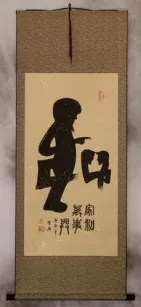
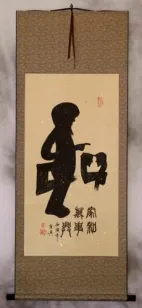
| Safe and Sound | 平安 | heian | píng ān / ping2 an1 / ping an / pingan | p`ing an / pingan / ping an |
| Safe and Sound | 平安無事 平安无事 | heian buji / heianbuji | píng ān wú shì ping2 an1 wu2 shi4 ping an wu shi pinganwushi | p`ing an wu shih pinganwushih ping an wu shih |
| In some entries above you will see that characters have different versions above and below a line. In these cases, the characters above the line are Traditional Chinese, while the ones below are Simplified Chinese. | ||||

Successful Chinese Character and Japanese Kanji calligraphy searches within the last few hours...



