Many custom options...


And formats...



Open Mind in Chinese / Japanese...
Buy an Open Mind calligraphy wall scroll here!
Personalize your custom “Open Mind” project by clicking the button next to your favorite “Open Mind” title below...
1. Open Mind
5. An Open Book Benefits Your Mind
10. Samadhi
11. 7. Right Mindfulness / Right Memory / Perfect Mindfulness
12. Devotion / Dedication / Attentive / Focused
13. Mindfulness
Open Mind
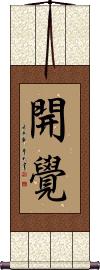
開覺 is a Buddhist term meaning “open mind.”
The more full definition as used in Buddhism is, “To arouse, awaken; to allow the original Buddha-nature to open and enlighten the mind.”
Listen with Open Mind
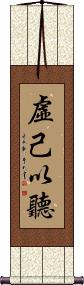
虛己以聽 is a Chinese proverb that means to listen to the ideas of others with an open mind.
Calm and Open Mind
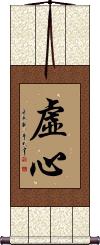
虛心 is a Buddhist term that speaks of being open-minded and/or having a calm and humble mind or heart.
Open and Calm Mind
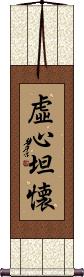
虛心坦懐 is a Japanese proverb that means “with an open and calm mind,” “with no preconceived notions,” or “without reservations.”
In some contexts, it can mean frank or candid.
If you want to remind yourself to approach each situation with no preconceptions, this is a good title for you. This can also refer to the ideas of being candid, frank, and straightforward.
An Open Book Benefits Your Mind
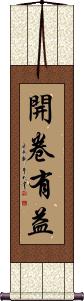
There are several ways to translate this ancient proverb. Translated literally and directly, it says, “Open roll has/yields benefit.”
To understand that, you must know a few things...
First, Chinese characters and language have deeper meanings that often are not spoken but are understood - especially with ancient texts like this. Example: It's understood that the “benefit” referred to in this proverb is to the reader's mind. Just the last character expresses that whole idea.
Second, Chinese proverbs are supposed to make you think and leave a bit of mystery to figure out.
Third, for this proverb, it should be noted that roll = book. When this proverb came about (about two thousand years ago), books were rolls of bamboo slips strung together. The first bound books like the ones we use today did not come about until about a thousand years after this proverb when they invented paper in China.
開卷有益 is a great gift for a bookworm who loves to read and increase their knowledge. Or for any friend that is or wants to be well-read.
Some other translations of this phrase:
Opening a book is profitable
The benefits of education.
Happy / Open Heart

In mordern times, 開心 means to feel happy, to rejoice, or to have a great time, but directly translates as open heart.
In the Buddhist context, beyond opening the heart, it can mean to develop the mind, to initiate into truth, or awaken the mind.
開 = Open.
心 = Heart/Mind.
Not commonly used in Japanese where it might be read as open-mindeness.
Open Your Heart

敞開心扉 is the most common way to express the idea of “Opening your heart” in Chinese.
This phrase is made up or two words:
敞开 = To open wide, to be unrestricted.
心扉 = Inner heart or soul.
If you want it brokend down further into individual characters:
敞 = Open to the view of all people, spacious, to open wide, or to disclose.
开 = Open, to start, or the beginning.
心 = Heart/Mind
扉 = Door, gate, opening, or the title page.
So maybe you can say, “To open wide the door of your heart and mind to all.”
Other variations of “open your heart” also exist such as 打開心扉, 敞開你的心扉, 打開你的心, and Simplified Chinese 敞开心扉, 打开心扉, 敞开你的心扉, or 打开你的心. These are also correct, but not as commonly used as 敞開心扉.
Mind Your Own Business
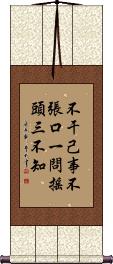
不干己事不张口一问摇头三不知 literally translates as [About] matters [that] don't concern [you], do not open [your] mouth, [and] when questioned, always shake [your] head “No.”
Figuratively, this means: It is best to remain reticent about other people's affairs and to refuse to make any comment on matters that don't concern you.
Learning is Eternal
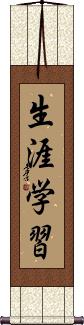
生涯學習 means “Learning is Eternal” or “Lifelong Learning,” in Japanese.
See Also: An Open Book Benefits Your Mind | Wisdom | Learn From Wisdom
Learning is Eternal
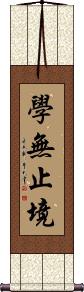
This Chinese philosophy tells of how we continue to learn throughout our lives.
This proverb can be translated in a few ways such as “Study has no end,” “Knowledge is infinite,” “No end to learning,” “There's always something new to study,” or “You live and learn.”
The deeper meaning: Even when we finish school we are still students of the world gaining more knowledge from our surroundings with each passing day.
See Also: An Open Book Benefits Your Mind | Wisdom | Learn From Wisdom
Samadhi
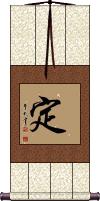
定 is the single-character way to express the idea of Samadhi in Chinese and Japanese.
A single-character title like this is open to many interpretation. So 定 can mean to set, to fix, to determine, to decide, to order, certainly, truly, settle, or compose the mind.
In the Buddhist context, this means “Perfect absorption of thought into the one object of meditation,” “The mind fixed in one direction,” “Internal state of imperturbability or tranquility,” or “Exempt from all external sensations.”
7. Right Mindfulness / Right Memory / Perfect Mindfulness
Samyak Smriti / Samyak Smrti / Samma Sati
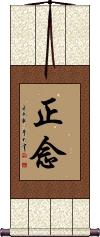
正念 is one of the Noble Eightfold Paths of Buddhism. Right Mindfulness, along with Right Effort and Right Concentration, constitute the path to Concentration or Perfect Thought.
Right Mindfulness is about remaining focused on one's body, feelings, mind, and mental qualities. It's also about being ardent, aware, and mindful, and supposes that you've already put aside worldly desire and aversion.
Monk Bhikkhu Bodhi described this as “The mind is deliberately kept at the level of bare attention, a detached observation of what is happening within us and around us in the present moment.” When practicing right mindfulness, the mind is trained to remain in the present, open, quiet, and alert, contemplating the present event.
Another definition: Ongoing mindfulness of body, feelings, thinking, and objects of thought.
This term is exclusively used by devout Buddhists. It is not a common term, and remains an unknown concept to most Japanese and Chinese people.
See Also: Buddhism | Enlightenment | Noble Eightfold Path
Devotion / Dedication / Attentive / Focused
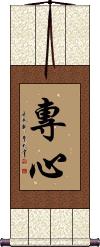
專心 makes a word that means “paying attention with your heart.”
It's often translated as “dedication,” as in “be absorbed in” or “concentrate one's efforts.” It's also used to mean “with the single mind,” “whole-heartedly,” “paying attention,” “undivided attention,” “concentration (-ed),” “engrossed,” “devotionally (listening/watching),” and/or “attentive.”
The first character means “for a particular person, occasion, or purpose,” “focused on one single thing,” “concentrated,” and sometimes, “special.”
The second character means “heart” or “mind” by itself.
My favorite translation, which comes from the Oxford Advanced Chinese/English Dictionary, is, “wholehearted devotion.”
If it seems like the meaning of this word is quite open, you are correct. The context in which the word is used matters a lot. It can mean different things depending on how you use it. This makes it useful as you can decide what this means to you (within some limits). This is always positive in meaning, so even if a Chinese person reads it differently than you, it will still have a good meaning.
 In Japanese, they tend to use a variation of the second character which has one less stroke. If you want your calligraphy written this Japanese form, please click on the Kanji shown to the right instead of the button above. Note: Japanese and Chinese people will recognize either form.
See Also: Faith | Sincerity and Devotion
Mindfulness
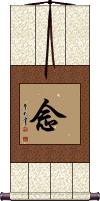
念 is the simplest way to write “mindfulness” in Chinese, Japanese Kanji, and old Korean Hanja.
念 can be defined these ways: To read; to study (a degree course); to read aloud; to miss somebody (keeping them in your mind); idea; remembrance; sense; thought; feeling; desire; concern; attention; recollection; memory; to think on/about; reflect; repeat, intone; a moment.
Obviously, the context in which the character is used determines which definition or meaning is perceived. As a single character, it's open and perhaps ambiguous. Thus, it can be read with any or all of these meanings.
念 is used in a Buddhist context (often written as 正念 or “right mindfulness”) with similar meanings of thought and contemplation.
In Japanese, this character is sometimes used as the name “Nen.”
See Also: Buddhism | Enlightenment
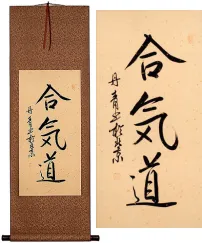
This in-stock artwork might be what you are looking for, and ships right away...



The following table may be helpful for those studying Chinese or Japanese...
| Title | Characters | Romaji (Romanized Japanese) | Various forms of Romanized Chinese | |
| Open Mind | 開覺 开觉 | kaikaku | kāi jué / kai1 jue2 / kai jue / kaijue | k`ai chüeh / kaichüeh / kai chüeh |
| Listen with Open Mind | 虛己以聽 虚己以听 | xū jǐ yǐ tīng xu1 ji3 yi3 ting1 xu ji yi ting xujiyiting | hsü chi i t`ing hsüchiiting hsü chi i ting |
|
| Calm and Open Mind | 虛心 虚心 | ko shin / koshin | xū xīn / xu1 xin1 / xu xin / xuxin | hsü hsin / hsühsin |
| Open and Calm Mind | 虛心坦懐 虚心坦懐 | kyo shin tan kai kyoshintankai | ||
| An Open Book Benefits Your Mind | 開卷有益 开卷有益 | kāi juàn yǒu yì kai1 juan4 you3 yi4 kai juan you yi kaijuanyouyi | k`ai chüan yu i kaichüanyui kai chüan yu i |
|
| Happy Open Heart | 開心 开心 | kai shin / kaishin | kāi xīn / kai1 xin1 / kai xin / kaixin | k`ai hsin / kaihsin / kai hsin |
| Open Your Heart | 敞開心扉 敞开心扉 | chǎng kāi xīn fēi chang3 kai1 xin1 fei1 chang kai xin fei changkaixinfei | ch`ang k`ai hsin fei changkaihsinfei chang kai hsin fei |
|
| Mind Your Own Business | 不干己事不張口一問搖頭三不知 不干己事不张口一问摇头三不知 | bù gān jǐ shì bù zhāng kǒu yī wèn yáo tóu sān bù zhī bu4 gan1 ji3 shi4 bu4 zhang1 kou3 yi1 wen4 yao2 tou2 san1 bu4 zhi1 bu gan ji shi bu zhang kou yi wen yao tou san bu zhi | pu kan chi shih pu chang k`ou i wen yao t`ou san pu chih pu kan chi shih pu chang kou i wen yao tou san pu chih |
|
| Learning is Eternal | 生涯學習 生涯学習 | shougai gakushuu shougaigakushuu shogai gakushu | ||
| Learning is Eternal | 學無止境 学无止境 | xué wú zhǐ jìng xue2 wu2 zhi3 jing4 xue wu zhi jing xuewuzhijing | hsüeh wu chih ching hsüehwuchihching |
|
| Samadhi | 定 | sada | dìng / ding4 / ding | ting |
| 7. Right Mindfulness Right Memory Perfect Mindfulness | 正念 | sei nen / seinen | zhèng niàn zheng4 nian4 zheng nian zhengnian | cheng nien chengnien |
| Devotion Dedication Attentive Focused | 專心 / 専心 / 耑心 专心 | sen shin / senshin | zhuān xīn zhuan1 xin1 zhuan xin zhuanxin | chuan hsin chuanhsin |
| Mindfulness | 念 | nen | niàn / nian4 / nian | nien |
| In some entries above you will see that characters have different versions above and below a line. In these cases, the characters above the line are Traditional Chinese, while the ones below are Simplified Chinese. | ||||

Successful Chinese Character and Japanese Kanji calligraphy searches within the last few hours...



