Many custom options...


And formats...



Not what you want?
Try other similar-meaning words, fewer words, or just one word.
Open Door in Chinese / Japanese...
Buy an Open Door calligraphy wall scroll here!
Personalize your custom “Open Door” project by clicking the button next to your favorite “Open Door” title below...
1. Open Door
2. Flowers Fall / The End Comes
4. Baby
5. Worldwide Wish for Peace and Prosperity
6. Optimistic
7. Ba Ji Quan
8. Guanxi
Open Door
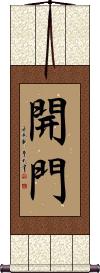
開門 means “to open a door,” “opening gate” or figuratively, “to open for business.”
Flowers Fall / The End Comes
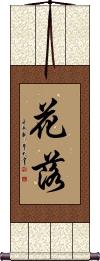
花落 means flower fall (closes and loses its petals).
It suggests nearing the end of something. A time that some might call “The sunset of life.” 花落 often follows 花開 or “flower open” to talk of the cycle of life.
We offer this as a possible companion to a “flower open” scroll (to be placed side by side or at either side of a doorway to say “things come and go” - a cool metaphor for a doorway). If placed in a doorway, it could be used to suggest to your guests that things bloom when they arrive through your door but wither when they leave (a great compliment).
See Also: Om
Open Your Heart

敞開心扉 is the most common way to express the idea of “Opening your heart” in Chinese.
This phrase is made up or two words:
敞开 = To open wide, to be unrestricted.
心扉 = Inner heart or soul.
If you want it brokend down further into individual characters:
敞 = Open to the view of all people, spacious, to open wide, or to disclose.
开 = Open, to start, or the beginning.
心 = Heart/Mind
扉 = Door, gate, opening, or the title page.
So maybe you can say, “To open wide the door of your heart and mind to all.”
Other variations of “open your heart” also exist such as 打開心扉, 敞開你的心扉, 打開你的心, and Simplified Chinese 敞开心扉, 打开心扉, 敞开你的心扉, or 打开你的心. These are also correct, but not as commonly used as 敞開心扉.
Baby
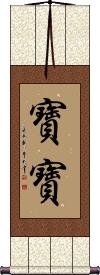
寶寶 is how Chinese people express “baby.”
The word is composed of the same character twice, and therefore literally means “double precious” or “double treasure.”
This would be a nice wall scroll to put either inside or by the door of your baby's room (not on the door, as wall scrolls swing around wildly when hung on doors that open and close a lot).
Worldwide Wish for Peace and Prosperity
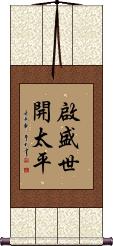
啟盛世開太平 means “To bring flourishing peace and security to the world (our current era).”
It's a wish that a new door leading to peace and prosperity could be opened to mankind.
Character and word breakdown:
啟 to open; to start; to initiate; to enlighten or awaken.
盛世 a flourishing period; period of prosperity; a golden age.
開 to open; to start; to turn on.
太平 peace and security; peace and tranquility; peace; tranquility.
I don't like to do breakdowns like this, as the words altogether create their unique meaning (encompassed in the main title above).
Optimistic
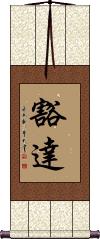
Beyond optimistic, 豁達 can also be defined as sanguine; magnanimous; open-minded; openhearted; broad-minded.
豁達 is appropriate if you are, or want to be, the kind of person who is not bothered by the little things or minor troubles of life. This signifies a person who always feels things will get better. This is great for the person who figuratively sees a window of opportunity opening even as a door closes.
While a valid word in Japanese, this is kind of antiquated, and not in common use in modern Japan.
Ba Ji Quan
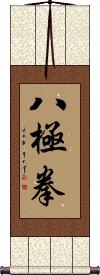
八極拳 is “Ba Ji Quan” or “Eight Extremes Fist.”
Some also translate this as “Eight Extremities Fist,” though I don't feel that's accurate.
八極拳 (Bājíquán) is a Chinese martial art that features explosive, short-range power and is famous for its elbow strikes. It originated in the Hebei Province in Northern China but spread to Taiwan and other places.
The full title is 開門八極拳 (Kāimén Bājíquán), which means Open-Door Bajiquan.
Other romanizations include: BaJiQuan, Pa Chi Ch`üan, or Pa Chi Chuan.
In Japan, this is known as Hakkyokuken.
Guanxi
The Chinese Concept of Relationship and Exchange of Favors
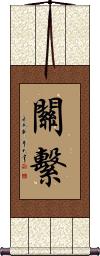
The dictionary definition is:
Relations/relationship, to concern, to affect, to have to do with, or connection.
But there's more to it...
In China, the relationship that you have with certain people can open doors for you. Having guanxi with someone also means they would never defraud you but are honor-bound to treat you fairly (of course, this goes both ways). Sometimes it is suggested that guanxi is the exchange of favors. 關繫 / 関繫 / 關係 is more about having a relationship that allows you to ask for and expect favors without shame.
There is no concept in western culture that exactly matches guanxi, but perhaps having a social or professional network is similar.
Note that there are some variations common within Chinese, Japanese Kanji, and Korean Hanja for this word... Japanese tend to use a Chinese alternate form as shown to the right for
the first character.
 There's also another alternate form of that first character (currently used as the official Simplified form in mainland China) which looks like the character shown to the right. It's basically the central radical of the alternate version shown above but without the “door radical” around it. In more free-flowing calligraphy styles, this version would be the likely choice for a calligrapher.
 In Modern Japanese, they use the character shown to the right.
They also tend to use this same form in Korean Hanja (I've only checked this word in my Korean dictionary, but it has not been confirmed by a translator's review).
 If that was not confusing enough, there is another alternate form of that second character. See right.
An Asian calligrapher of any nationality may use these forms at their discretion. However, They would tend to stick to the most common form used in their respective languages.
If you have any preference on any of these issues, please give us a special note with your order, and we'll make sure it's done the way you want.
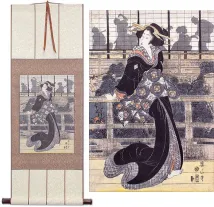
This in-stock artwork might be what you are looking for, and ships right away...

The following table may be helpful for those studying Chinese or Japanese...
| Title | Characters | Romaji (Romanized Japanese) | Various forms of Romanized Chinese | |
| Open Door | 開門 开门 | kai mon / kaimon | kāi mén / kai1 men2 / kai men / kaimen | k`ai men / kaimen / kai men |
| Flowers Fall The End Comes | 花落 | huā sà / hua1 luo4 / hua luo / hualuo | hua lo / hualo | |
| Open Your Heart | 敞開心扉 敞开心扉 | chǎng kāi xīn fēi chang3 kai1 xin1 fei1 chang kai xin fei changkaixinfei | ch`ang k`ai hsin fei changkaihsinfei chang kai hsin fei |
|
| Baby | 寶寶 宝宝 | bǎo bao / bao3 bao / bao bao / baobao | pao pao / paopao | |
| Worldwide Wish for Peace and Prosperity | 啟盛世開太平 启盛世开太平 | qǐ shèng shì kāi tài píng qi3 sheng4 shi4 kai1 tai4 ping2 qi sheng shi kai tai ping qishengshikaitaiping | ch`i sheng shih k`ai t`ai p`ing chishengshihkaitaiping chi sheng shih kai tai ping |
|
| Optimistic | 豁達 豁达 | katsudatsu | huò dá / huo4 da2 / huo da / huoda | huo ta / huota |
| Ba Ji Quan | 八極拳 八极拳 | hakkyo ku ken hakkyokuken hakyo ku ken | bā jí quán ba1 ji2 quan2 ba ji quan bajiquan | pa chi ch`üan pachichüan pa chi chüan |
| Guanxi | 關繫 / 関繫 / 關係 关系 / 関係 | kankei | guān xì / guan1 xi4 / guan xi / guanxi | kuan hsi / kuanhsi |
| In some entries above you will see that characters have different versions above and below a line. In these cases, the characters above the line are Traditional Chinese, while the ones below are Simplified Chinese. | ||||

Successful Chinese Character and Japanese Kanji calligraphy searches within the last few hours...



