Many custom options...


And formats...



Leadership in Chinese / Japanese...
Buy a Leadership calligraphy wall scroll here!
Personalize your custom “Leadership” project by clicking the button next to your favorite “Leadership” title below...
1. Leadership
3. Leadership / Ability to Lead
4. The Confident Helmsman Inspires Confidence in the Passengers
6. Woo
7. Tung
8. Hoang
9. Huynh
Leadership
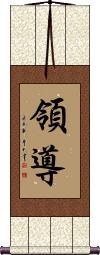
領導 is the Chinese word for “Leadership.”
It contains the ideas of “to lead,” “to direct,” “to conduct,” and “to guide.” Putting a wall scroll with this word on your wall suggests that you are honing your leadership skills or holding a leadership position.
Initiative / Leadership
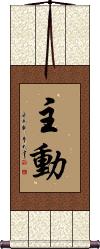
In Chinese, this word means “to take the initiative.”
In Japanese and Korean, the meaning varies slightly to meaning that leans more toward “leadership” (as in one who is leading a group or organization).
Leadership / Ability to Lead
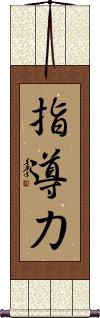
指導力 is the Japanese word for “Leadership.”
This refers to the ability to lead (or, with certain adjectives added, the lack of ability to lead).
The Confident Helmsman Inspires Confidence in the Passengers
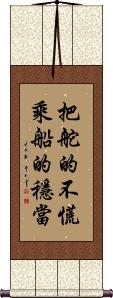
把舵的不慌乘船的稳当 is a Chinese proverb that literally translates as: [If the] helmsman is not nervous, the passengers [will feel] secure.
Figuratively, this means: If the leader appears confident, his/her followers will gain confidence also.
This is a great suggestion that a confident leader inspires confidence in his/her troops or followers. Of course, a nervous leader will create fear in troops or followers.
Hou De Zai Wu
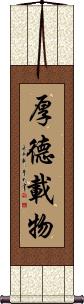
厚德載物 is a Chinese proverb that means “With great virtue, one can take charge of the world.”
Known sometimes by the romanization Hou De Zai Wu, this famous phrase suggests that being ethical is the bridge to leadership. I wish our world leaders followed this.

伍 is a Cantonese surname that can romanize as Woo.
There is more than one Woo: The surname "Woo" (우/吳/胡/禹/武) is common in East Asia, primarily Chinese and Korean, stemming from various characters with different origins, often romanized from Cantonese (like 吳 Wú or 胡 Hú) or Korean (like 禹), meaning leadership, history, or related to ancient states and figures like Yu the Great, symbolizing diligence and heritage.
Tung

董 is a Cantonese surname that romanizes as Tung.
This is not the only Tung: The surname Tung is primarily of Chinese origin, a Cantonese/Mandarin romanization for several Chinese characters (like 董, 童, 佟, 東) meaning things like "supervise," "child," or "east," often linked to leadership or nature (pine tree). It's also found in Vietnamese contexts as "Tùng," meaning "pine," and signifies a connection to East Asian heritage, prevalent in China, Hong Kong, US, and Southeast Asia.
Hoang
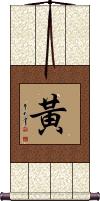
黃 is the original Chinese character for the Vietnamese surname Hoang or Hoàng.
This is one of the most common Vietnamese surnames. It originates from the Chinese surname Huang (黃), meaning "yellow," and also used for "phoenix" or "bright/luminous," signifying nobility and leadership, popular across East Asia and among the Vietnamese diaspora, often sharing roots with Korean Hwang and Chinese Wang.
Adopted in Vietnam where it signifies imperial lineage, courage (phoenix), or brightness, with variations like Hoàng (northern) and Huỳnh (southern).
Huynh
黃 is the original Chinese character for the Vietnamese surname Huynh or Huỳnh.
黃 is one of the most common Vietnamese surnames. It originates from the Chinese surname Huang (黃), meaning "yellow," and also used for "phoenix" or "bright/luminous," signifying nobility and leadership, popular across East Asia and among the Vietnamese diaspora, often sharing roots with Korean Hwang and Chinese Wang.
Adopted in Vietnam where it signifies imperial lineage, courage (phoenix), or brightness, with variations like Hoàng (northern) and Huỳnh (southern).
Art of War: 5 Points of Analysis
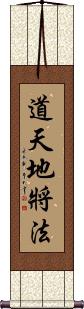
道天地將法 is a list of five key points to analyzing your situation from the first chapter of Sun Tzu's Art of War.
This reads like a 5-part military proverb. Sun Tzu says that to sharpen your skills, you must plan. To plan well, you must know your situation. Therefore, you must consider and discuss the following:
1. Philosophy and Politics: Make sure your way or your policy is agreeable among all of your troops (and the citizens of your kingdom as well). For when your soldiers believe in you and your way, they will follow you to their deaths without hesitation and will not question your orders.
2. Heaven/Sky: Consider climate / weather. This can also mean considering whether God is smiling upon you. In the modern military, this could be waiting for clear skies so that you can have air support for an amphibious landing.
3. Ground/Earth: Consider the terrain in which the battle will take place. This includes analyzing defensible positions, and exit routes, while using varying elevations to your advantage. When you plan an ambush, you must know your terrain and the best location from which to stage that ambush. This knowledge will also help you avoid being ambushed, as you will know where the likely places in which to expect an ambush from your enemy.
4. Leadership: This applies to you as the general and your lieutenants. A leader should be smart and be able to develop good strategies. Leaders should keep their word, and if they break a promise, they should punish themselves as harshly as they would punish subordinates. Leaders should be benevolent to their troops, with almost a fatherly love for them. Leaders must have the ability to make brave and fast decisions. Leaders must have steadfast principles.
5. [Military] Methods: This can also mean laws, rules, principles, models, or systems. You must have an efficient organization in place to manage both your troops and supplies. In the modern military, this would be a combination of how your unit is organized and your SOP (Standard Operating Procedure).
Notes: This is a simplistic translation and explanation. Much more is suggested in the actual text of the Art of War (Bing Fa). It would take a lot of study to master all of these aspects. In fact, these five characters can be compared to the modern military acronyms such as BAMCIS or SMEAC.
CJK notes: I have included the Japanese and Korean pronunciations but in Chinese, Korean and Japanese, this does not make a typical phrase (with subject, verb, and object) it is a list that only someone familiar with Sun Tzu’s writings would understand.
This in-stock artwork might be what you are looking for, and ships right away...
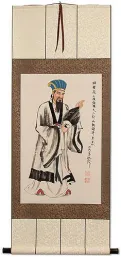
Gallery Price: $71.00
Your Price: $39.00
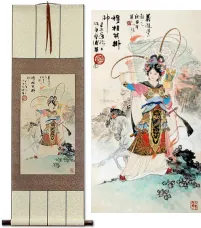
Gallery Price: $108.00
Your Price: $59.88
The following table may be helpful for those studying Chinese or Japanese...
| Title | Characters | Romaji (Romanized Japanese) | Various forms of Romanized Chinese | |
| Leadership | 領導 领导 | lǐng dǎo / ling3 dao3 / ling dao / lingdao | ling tao / lingtao | |
| Initiative Leadership | 主動 主动 | shudou / shudo | jī jí / ji1 ji2 / ji ji / jiji | chi chi / chichi |
| Leadership Ability to Lead | 指導力 指导力 | shidouryoku shidoryoku | ||
| The Confident Helmsman Inspires Confidence in the Passengers | 把舵的不慌乘船的穩當 把舵的不慌乘船的稳当 | bǎ tuò de bù huāng chéng chuán de wěn dang ba3 tuo4 de bu4 huang1 cheng2 chuan2 de wen3 dang ba tuo de bu huang cheng chuan de wen dang | pa t`o te pu huang ch`eng ch`uan te wen tang pa to te pu huang cheng chuan te wen tang |
|
| Hou De Zai Wu | 厚德載物 厚德载物 | hòu dé zài wù hou4 de2 zai4 wu4 hou de zai wu houdezaiwu | hou te tsai wu houtetsaiwu |
|
| Woo | 伍 | wǔ / wu3 / wu | ||
| Tung | 董 | dǒng / dong3 / dong | tung | |
| Hoang | 黃 黄 | huáng / huang2 / huang | ||
| Huynh | 黃 黄 | huáng / huang2 / huang | ||
| Art of War: 5 Points of Analysis | 道天地將法 道天地将法 | dou ten chi shou hou doutenchishouhou do ten chi sho ho | dào tiān dì jiàng fǎ dao4 tian1 di4 jiang4 fa3 dao tian di jiang fa daotiandijiangfa | tao t`ien ti chiang fa taotientichiangfa tao tien ti chiang fa |
| In some entries above you will see that characters have different versions above and below a line. In these cases, the characters above the line are Traditional Chinese, while the ones below are Simplified Chinese. | ||||

Successful Chinese Character and Japanese Kanji calligraphy searches within the last few hours...



